
ZePrA | Queues

Queues

Manage print jobs

Queues

Overview

In ZePrA, files are processed via queues, and each queue is assigned a configuration or a flow. A configuration/flow contains all the necessary settings for converting and processing files. Queues and their configurations/flows are managed separately, and configurations/flows can be reassigned to queues at any time.

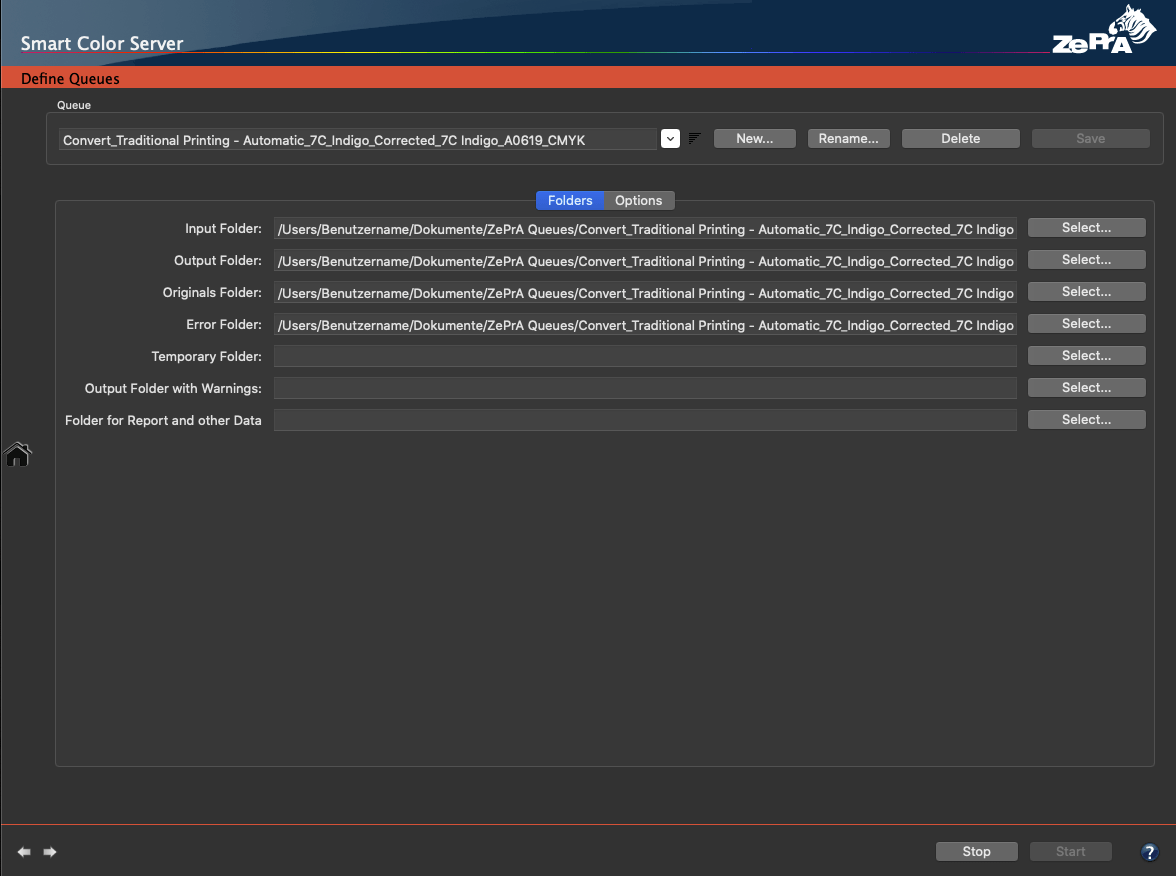
The Define Queues window (Sidebar: Overview) provides an overview of the existing queues and their associated configurations/flows.

Note: The Queue drop-down menu functions like a search field. Simply type in some letters of the desired queue and only those queues containing these letters will be shown in the list. Alternatively you may open the drop-down menu with the little arrow on the right and select a queue from the full list as usual. The settings of the selected queue are shown below under Folders and Options.

Define the sort order of the queues on the right side of the drop-down menu.

There are two options: Alphanumeric sorting Name (A-Z) or default sorting, where the oldest queues are at the top and the newest at the bottom of the list.

Automatically Setting up Queues

We recommend using the Auto Setup Wizard to create new queues for all typical standard-compliant workflows. It simplifies the process by automatically creating hotfolders and assigning the required configurations. If you work with ColorLogic's standard DeviceLink profiles, the Auto Setup also adds all relevant PDF/X information automatically.
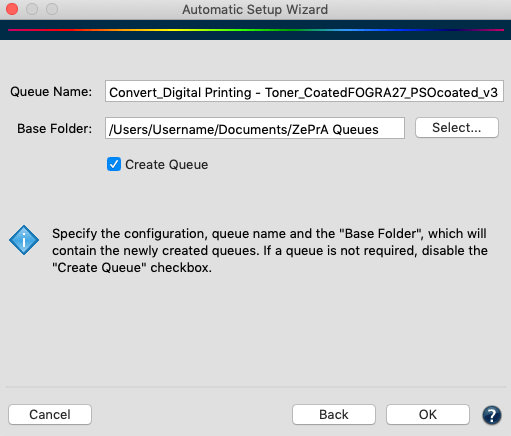
Queues can be created in Auto Setup

Manually Setting up Queues

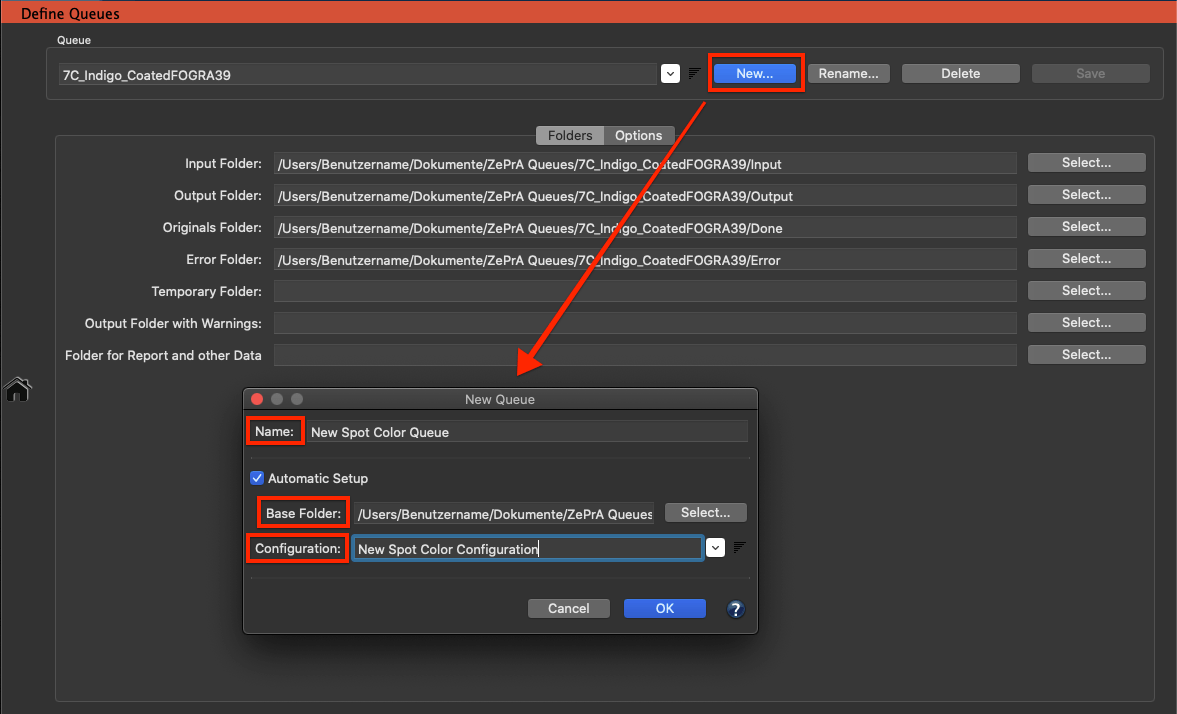
To create a new queue, a Base Folder must be created, a Configuration must be assigned, and a Name must be entered.

New: Use the New button to create and name a queue manually. By activating the Automatic Setup checkbox, you can immediately assign a Configuration from the drop-down menu to the new queue. The sort order of the configurations in the drop-down menu can be changed from default to alphanumeric via the icon on right.

Select None from the Configuration drop-down menu to assign no configuration to the new queue, for example, if you want the queue to receive Job Control Files only.
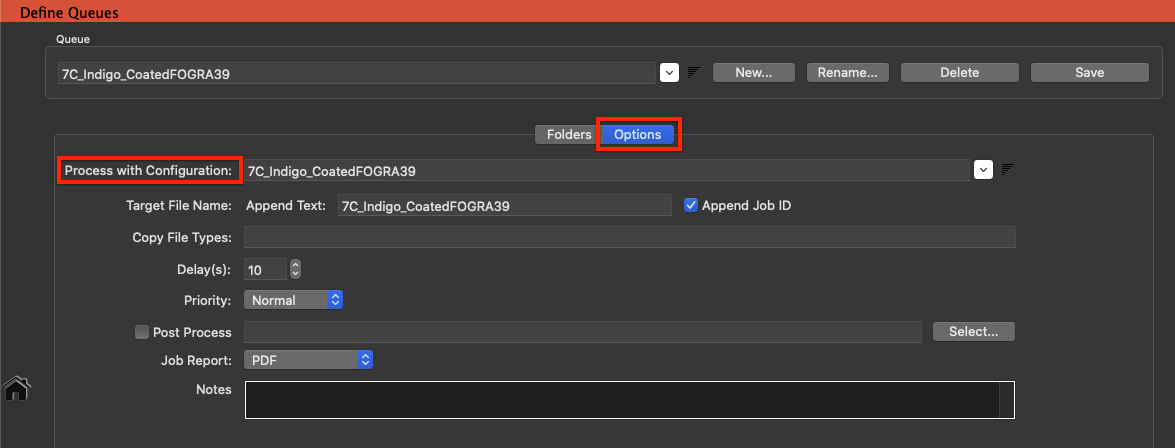
The configuration of a queue can be changed at any time. To assign a different configuration to a queue, select the desired configuration from the Process with Configuration drop-down menu in the Options tab.
Rename: Rename existing queues.

Delete: To delete queues.

Save: To save edited queues.

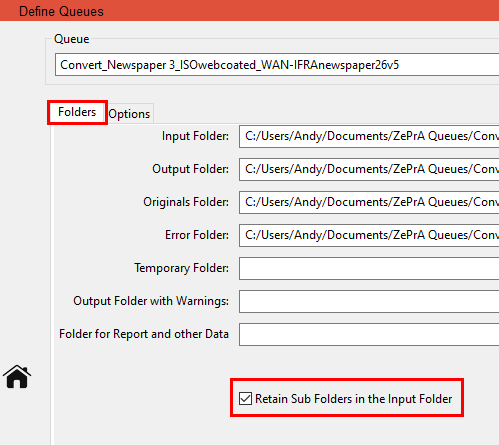
Folders

Input Folder: Sets the location for the Input folder of the queue. Copy or move the files to be converted into this folder. The files placed here are automatically processed using the settings of the assigned configuration.

Output Folder: Converted files are moved into this folder. The job ID and configuration name are added to the file name.

Originals Folder: The original files are moved into this folder (Done).

Note: If you do not want to keep the original files after the conversion, you can remove the path to the Done folder.
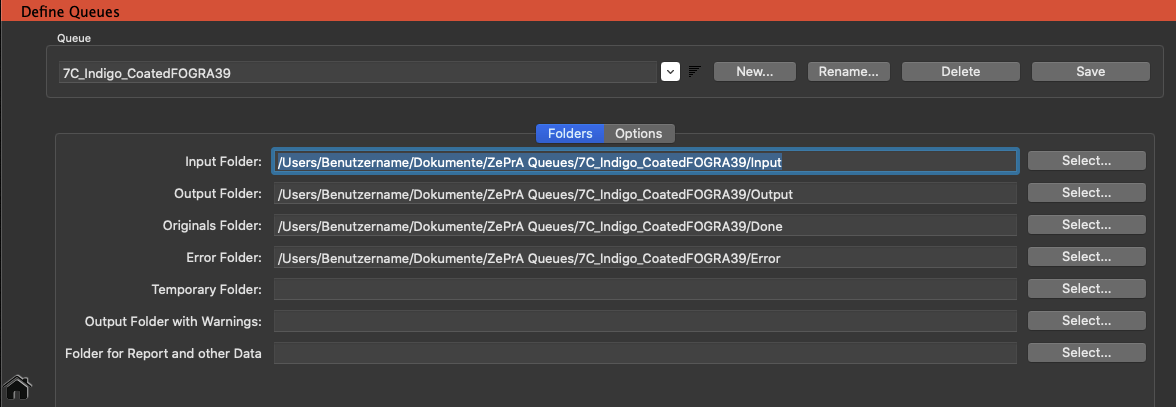
Temporary Folder: If the files are to be copied to a server or network drive, it is recommended to create a temporary folder on the local system to avoid unnecessary traffic over the network.

Error Folder: Incorrectly processed or unsupported file types are marked red in the Overview and moved to the Error folder.

Output Folder with Warnings: Files that could be processed, but may have a problem, will be stored in the Output folder and will be marked with a yellow warning in the Overview. Alternatively, you can also define an Output Folder with Warnings in which such files will be moved after processing.

At program start, all folders of a queue (Input, Output, etc) are checked for integrity. If a folder is missing or not writeable, the queue is stopped and a workflow warning is displayed.
When the program is running, the Input folder is constantly checked, while the other folders (Output, etc.) are not (for performance reasons).
If a job is being processed and cannot be written or moved to its destination folder, all folders in the queue are checked. If a queue has been stopped after checking, it will be started automatically when the folder is accessible again.

Retain Sub Folder in the Input Folder: Preserves empty subfolders in the Input folder while also preserving the original folder structure, which is important for workflows that require these subfolders.

Note: Whole folders with files can be inserted into the Input folder of a Queue. Normally, the files of this subfolder are processed and a subfolder with the same name is created in the Output folder, where the processed files are placed. At the same time, the subfolder of the Input folder is moved to the Done folder, so that the Input folder remains empty afterwards. Select this check box to preserve empty subfolders in the Input folder.
Options

Processing: Assigns a configuration or flow to the selected queue. The sort order of the configurations/flows in the drop-down menu can be changed from default to alphanumeric via the icon on the right. The configuration/flow of a queue can be changed at any time.
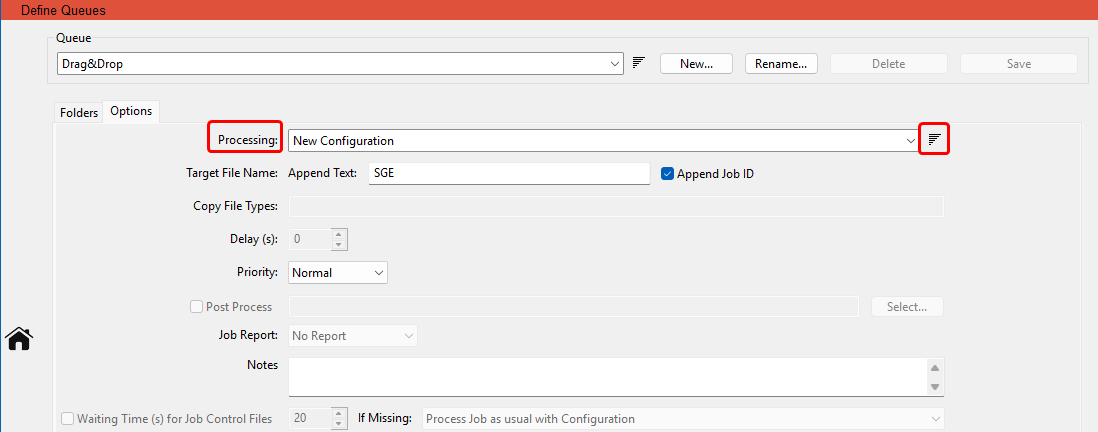
Note: Flows are only displayed in the list if the Flows module is present.

Target File Name: Append Text: Adds a suffix to the original file name. By default, this suffix corresponds to the respective Flow or Configuration name, but this can be customized.

In the case of a Link Flow involving multiple configurations, the names of all associated configurations are appended to the name of the output file.

User-defined texts or numbers can also be entered in the text field, which are then automatically appended.

Basically, this function uses placeholders, which are text elements that are automatically replaced by defined values. The default placeholder is $Auto, which automatically appends the appropriate Flow or Configuration name(s) to the output file name. Alternatively, the placeholders $Flow or $Configuration can be entered manually.

The placeholder $Configuration appends the name of the configuration to the converted file.
For Job Control Files, $Configuration appends the specified configuration name, or the base configuration selected from the control file.
If a configuration and its configuration name has been edited via Hold and Edit (in the Overview), when using $Configuration this configuration name is appended.

The placeholder $Flow appends the name of the flow to the output file.

Append Job ID: Uses the Job ID that is shown in the Overview dialog for the processed job and appends it to the original file name. If this function is disabled, a file that is converted a second time is overwritten in the Output folder using the same name.
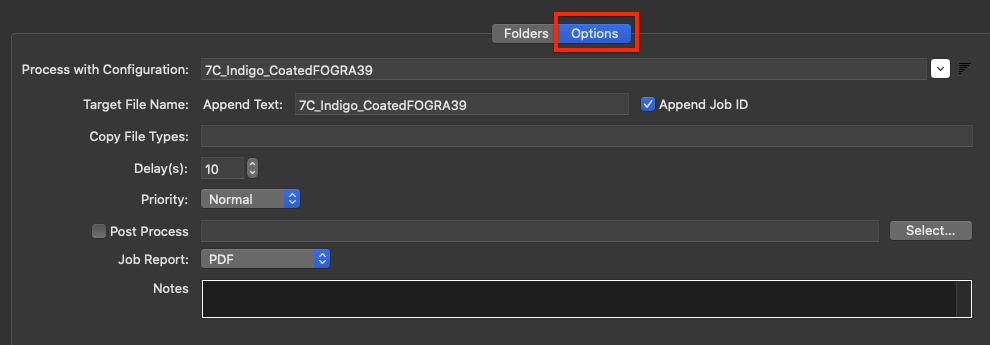
Copy File Types: Transfers job tickets in JDF, XML, TXT format or similar file types. Enter the formats in the text box and separate multiple formats with a comma.

If a job ticket has the same name as the processed file, it is copied to the Output folder and moved to the Done folder.

Post ProcessAfter conversion, a file can be processed further. To do so, activate the checkbox and select an application or a script file (e.g. a batch file under Windows or a shell script under macOS) which is to be used to open the converted file. This is equivalent to a drag-and-drop operation of the converted file onto the selected application or script.

To select a batch file or a Java Script file, specify the path to the corresponding file. Example for a batch file: C:\CL\Temp\example.bat, example for a Java Script: C:\CL\Temp\example.js

Note: To use Java scripts, a Java Script runtime environment like Node.js must be installed.
If you activate the checkbox without selecting an application or script, the converted file will be opened in the file manager (Finder in macOS, Explorer in Windows).
After processing, PDF files are opened with the standard PDF viewer, for example Adobe Acrobat.
Please make sure that the correct permissions are assigned to the script file, otherwise execution of the script will fail. This can be done via the console (terminal) with the command "chmod 755 /path/to/scriptfile.sh".

The Post Process function is not available for drag-and-drop queues.

Job Report: Creates a report in PDF, HTML, XML or text file format. Once created, it is saved under the original file name, followed by the REPORT addition.

Folder: Defines the location for the Job Report.

Delay(s): Processing of a job can be delayed which may be necessary if large files are copied to hot folders shared via the network using a slow connection. Enter the duration of the delay in seconds.

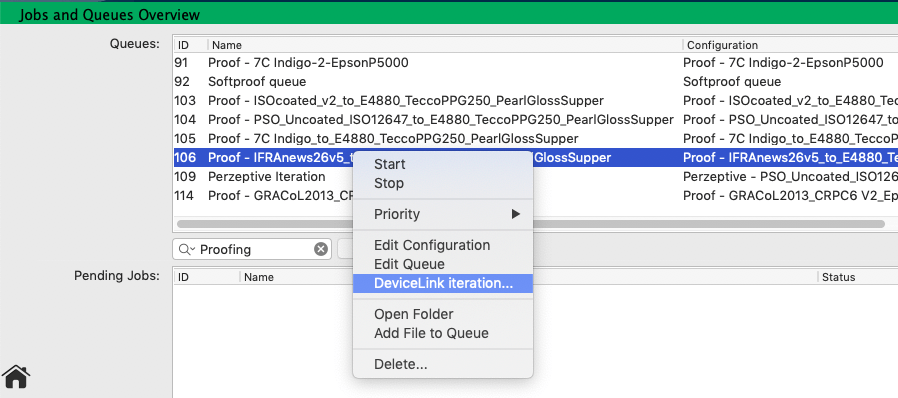
Priority: Their priority determines the order of the jobs to be processed. Change the Priority by right-clicking on the queue and change its default setting Normal to High or Low.

Notes: The use of notes is particularly useful when processing a large number of queues, configurations, and jobs with ZePrA. Notes have an integrated search function allowing information on machine parameters, paper information, or customer information to be linked to queues, configurations, or jobs, and later can be easily found using the search function in the Overview window.

Waiting Time (s) for Job Control Files: If Job Control Files are to be used to process a job, select the check box and enter the waiting time. This ensures that an associated Job Control File is waited for, rather than simply processing the job files directly as usual. Job Control Files contain the processing settings for the associated job and are placed in the Input folder with the files to be processed. For detailed information see Automation and Connectivity.

Notes: When a Job Control File matching a job is recognized, the job is processed immediately, even if the waiting time has not yet passed.
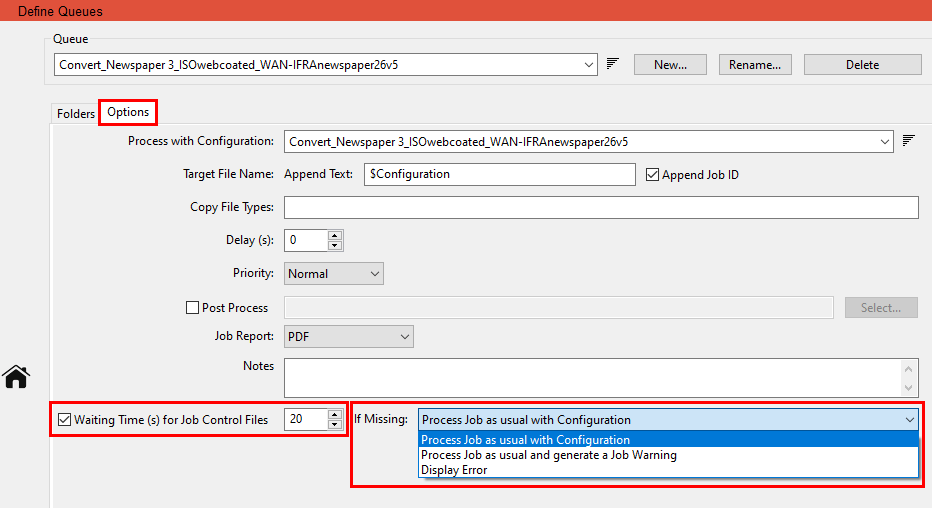
It is not mandatory to set a waiting time, since Job Control Files are always checked for, even if the check box is deselected. If the job to be processed and the Job Control File are placed in the Input folder simultaneously, an additional waiting time is rather not necessary. However, this depends on your workflow and the speed of the network.

If Missing: Specify how to proceed if no Job Control File is transmitted. There are three self-explanatory options:

  • Process Job as usual with Configuration
  • Process Job as usual and generate a Job Warning
  • Display Error
Using Queues
  1. Copy or move files to be converted to the Input folder of the queue. The files stored here are automatically processed using the settings of the assigned configuration.
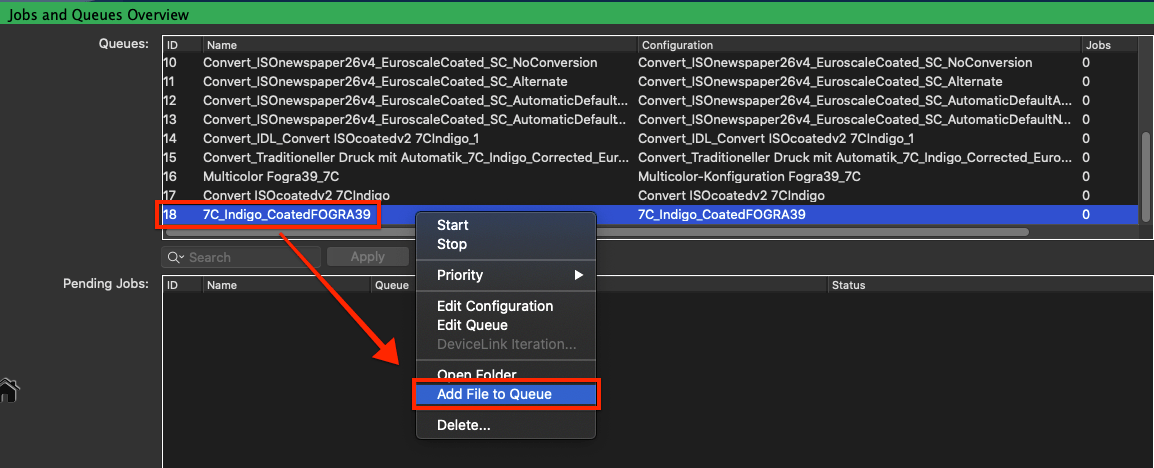
  2. The converted file is then moved to the Output folder. The job ID and configuration name are added to the file name.
  3. The original file is moved to the Done folder.
  4. If the files are to be copied to a server or network drive, it is recommended to create a Temporary folder on the local system.
  5. Incorrectly processed or unsupported file types are marked red in the Overview and moved to the Error folder. Files that could be processed, but might contain a problem, will be placed in the Output folder and a yellow warning will be displayed in the Overview. Alternatively, you can also define an Output Folder with Warnings in which such files will be moved after processing.

Tip: Configurations can be tested easily by dragging and dropping files to the desired queue in the Overview. The converted files are saved separately with the name of the configuration and Job ID as the name extension in addition to the original files.

ZePrA | Share with ZePrA

Share with ZePrA

Use CoPrA's DeviceLink settings in ZePrA

Share CoPrA's DeviceLink settings with ZePrA

Sharing settings with ZePrA (CoPrA 5 and lower)

Due to the close connection between CoPrA (ColorLogic’s profiling solution) and our color server ZePrA, the profile settings from CoPrA can be used to calculate DeviceLink profiles in ZePrA.

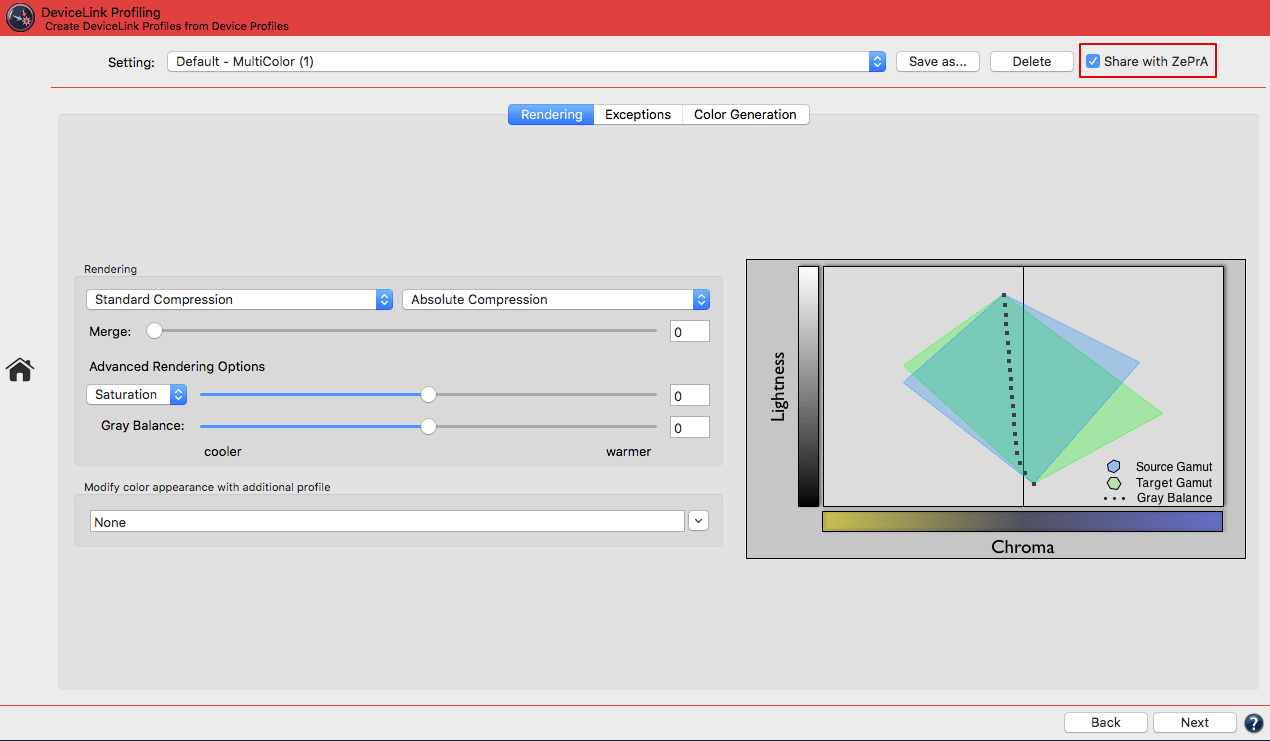
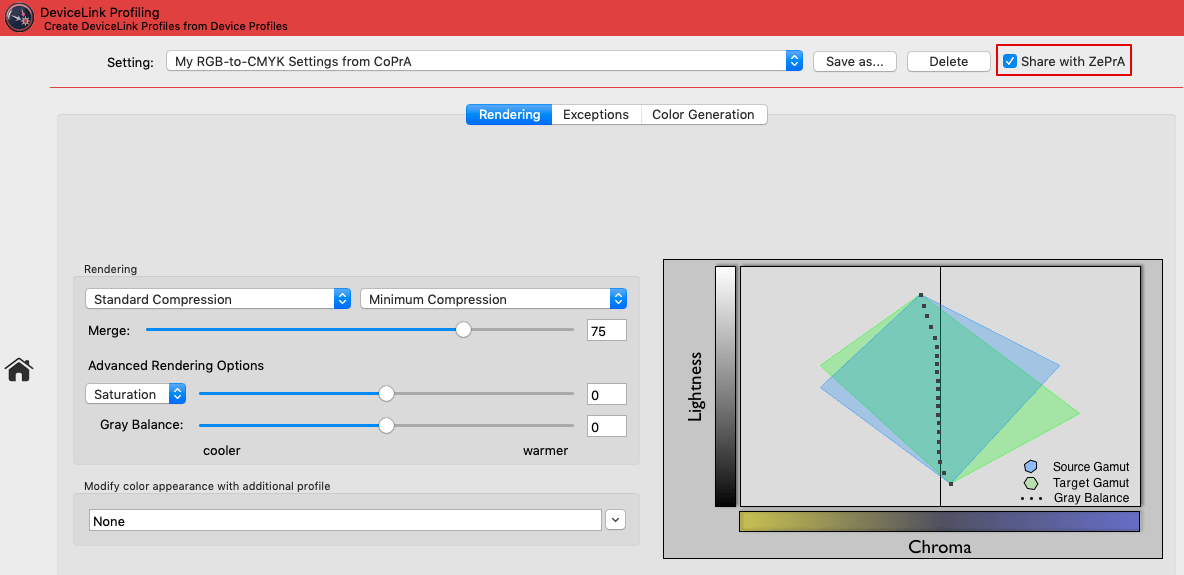
By selecting the checkbox Share with ZePrA in CoPrA, the settings of your DeviceLink and SaveInk profiles are transferred directly to ZePrA and can be used there as SmartLink Method.

The SmartLink Method in ZePrA allows calculation of the necessary DeviceLink and/or SaveInk profiles for the conversion of PDF files on-the-fly, without the need to create these DeviceLinks in advance.

The DeviceLink tool in CoPrA: SmartLink can use the profile settings from CoPrA to create DeviceLinks in ZePrA

To do so, make all the required settings in CoPrA by entering all relevant information in the DeviceLink tool under Rendering, Exceptions, and Color GenerationClick Save As and enter a name for the setting. Confirm with OK, then activate the Share with ZePrA checkbox. 

The so created methods shared with ZePrA are then available as SmartLink Method in the drop-down menus of both the Auto Setup and the Configurations.

Note: Only saved settings can be shared with ZePrA. Default or edited presets cannot be shared.

Sharing settings with ZePrA (CoPrA 6 and higher)

The SmartLink Method in ZePrA allows to create DeviceLinks and SaveInk profiles for the conversion of PDF files on-the-fly, without the need to create these DeviceLinks in advance.
Due to the close linkage between CoPrA and ZePrA, profiling settings specified in CoPrA can be used by ZePrA to create the required profiles.

The settings are accessible via a shared folder which has the advantage that CoPrA and ZePrA do not need to be installed on the same computer. The shared folder must simply be accessible by both ZePrA and CoPrA, either over the network, a shared local folder or the cloud.

Procedure

In CoPrA

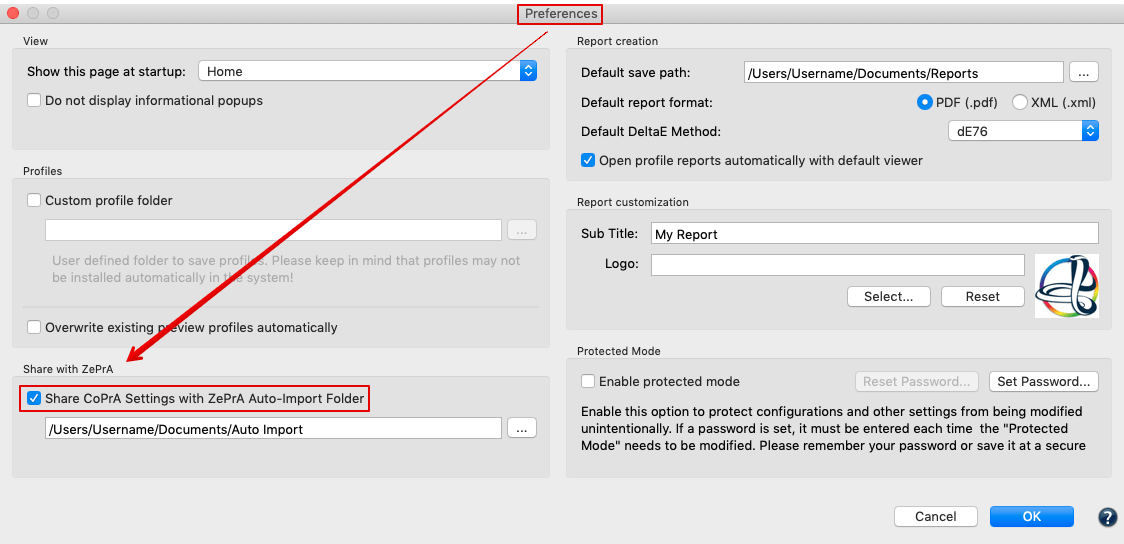
  1. Under Preferences, enable the checkbox Share CoPrA Settings with ZePrA Auto Import Folder and select ZePrA’s Auto Import folder.
    Note: The Auto Import folder must be activated in ZePrA as well.
    If the checkbox is enabled and the Preferences dialog closed with OK an information message will appear asking the user if all shared presets should now be copied to the defined Auto-Import Folder.

  2. In the DeviceLink tool, define all required settings by entering all relevant information under Rendering, Exceptions and Color Generation.
  3. Click Save As and enter a name for the setting. Confirm with OK, then activate the Share with ZePrA checkbox.

  4. CoPrA Settings created that way and shared with ZePrA are available for selection as SmartLink Method in the drop-down menus of both the Auto Setup and the Configurations settings.

Note: Only saved settings can be shared with ZePrA. Default or edited presets cannot be shared.

In ZePrA

Make sure to enable the Auto Import function in ZePrA’s Preferences and to use the same folder as CoPrA. CoPrA’s DeviceLink and SaveInk settings are now accessible in ZePrA and can be used there as a SmartLink Method. SmartLink can now create custom DeviceLinks which can be used in ZePrA configurations.

Basic information on the Auto Import folder

Files (such as ICC profiles, configurations, spot color libraries, gradations or SmartLink settings) that are moved or copied into the Auto Import folder are transferred to ZePrA’s internal dataset and can then be used by ZePrA.
When the file in the Auto Import folder is replaced by a newer version, it will be updated in ZePrA’s internal datasets as well.
Note: If a file in the Auto Import folder is deleted, it is not deleted in ZePrA’s internal dataset. For example if a SmartLink setting has been deleted in the Auto Import folder, it is still available in ZePrA’s internal dataset and if this setting is deleted in ZePrA’s dataset, it is still available in the Auto Import folder.

ZePrA | Configurations | Gradations

Gradations

Customize Gradation settings for specific configurations

Adding Gradations to a Configuration

Overview

Gradations are curves that can be applied to the individual data channels after color conversion. The procedure is similar to that for controlling the curves when imaging printing plates. Tone value corrections can be applied to both CMYK channels and to spot color channels with the help of gradations.

To apply gradation curves to otherwise print ready data with ZePrA, create corresponding configurations using the Auto Setup Wizard. The document color space will not be changed.

It is best to apply pure gradation corrections to print ready PDF/X 1a files that are comprised of only CMYK and possibly spot colors. For more detailed information Gradations and Auto Setup Wizard - Apply gradation curves only.

Applying Gradations

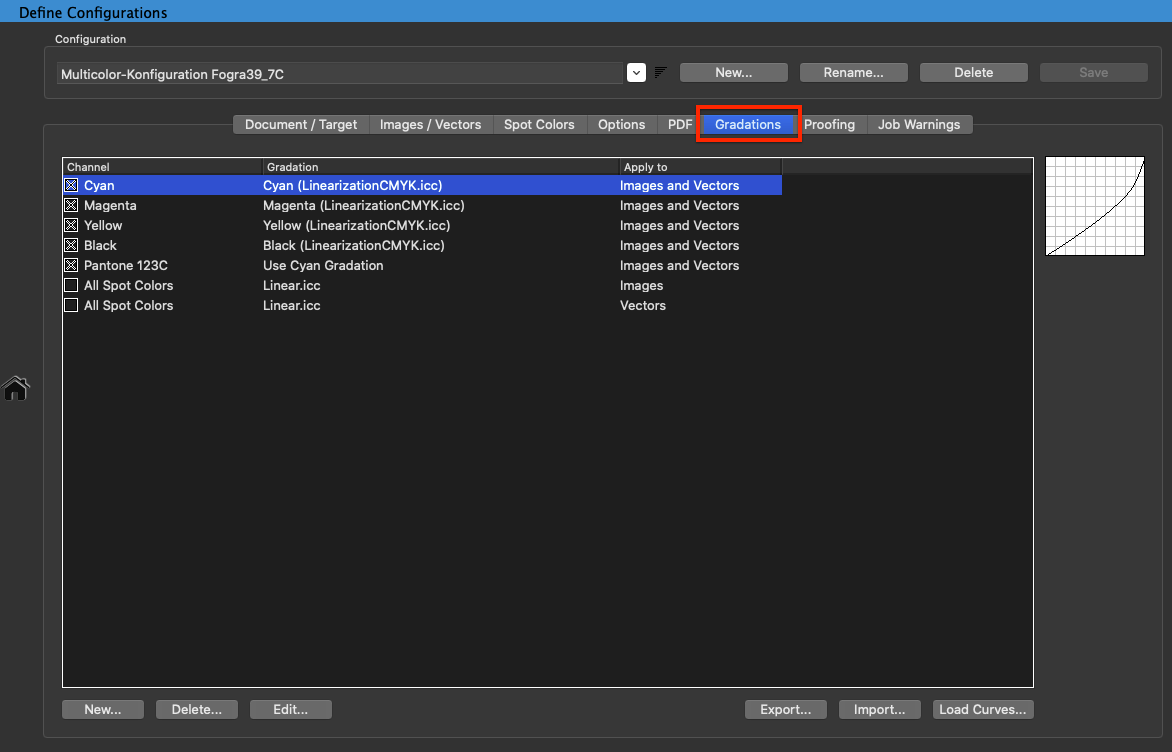
Via the Configurations option on the Sidebar, access the Define Configuration window and the Gradations tab. Not only can gradation adjustments be applied in the form of predefined gradation curves, but also gradation adjustments can be loaded from an external file and automatically applied to process and spot colors. This is also possible without any prior color management on process and/or spot colors. When updating the curves in this external file, the gradation curves are automatically adopted in the ZePrA configuration and applied to the printing data being processed. This enables short term adjustments of the pronging data without having to change the CTP curves in the RIP. With ZePrA, automatic color and printing control is possible not only for standard printing processes but also for digital printing machines. The gradation curves can be applied to both CMYK and the spot color changes of the file to be converted.

The basic colors Cyan, Magenta, Yellow, Black, as well as the entry All Spot Colors appear as fixed values at the top of the list and cannot be deleted or renamed. All Spot Colors allows to adjust all spot colors of the document quickly in one go. All DeviceN spot colors will be adjusted using the same (assigned) gradation curve.

The basic colors Cyan, Magenta, Yellow, Black, as well as the entries All Spot Colors (Images) and All Spot Colors (Vectors) appear as fixed values at the top of the list and cannot be deleted or renamed. All Spot Colors allows you to adjust all spot colors of the document quickly in one go. Since there are two entries for All Spot Colors (images and vectors) both entries must be changed if the same curve is to be applied to images and vectors. All DeviceN spot colors will be adjusted using the same (assigned) gradation curve.

Notes

  • When old configurations are loaded or imported and Apply Gradations to Images/Vector Graphics is disabled, the gradation rules will be modified accordingly.
  • Configurations which use individual image and vector rules should not be used in older ZePrA versions.

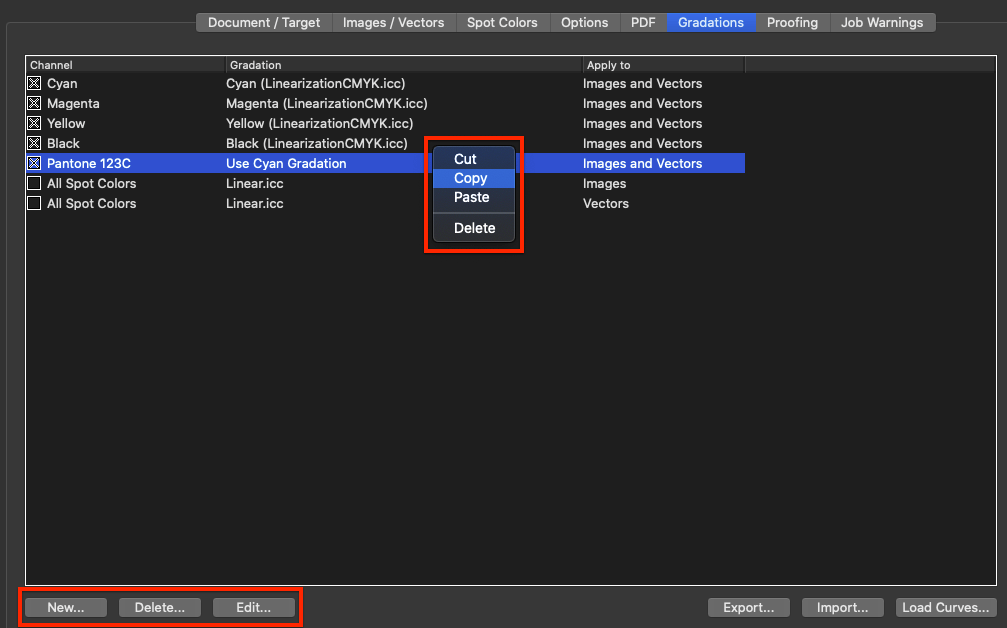
A right click on a channel opens a context menu which allows you to Cut, Copy, Paste or Delete the selected entry.

New: Creates further entries for adjusting the gradation of spot colors. Enter the Channel Name and select the required gradation curve.

Delete: Deletes the selected channel.

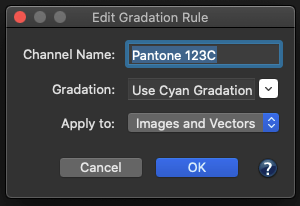
Edit: Opens the Edit Gradation Rule window to edit existing channels.

Channel Name: Enter a new name for the selected channel.

Gradation: Select a gradation curve.

Apply to: Applies the selected gradation curve to Images, Vectors or Images and Vectors.
Note: Individual curves can be applied to Images and Vectors by setting up two rules for one channel (for example, the Cyan channel), with one curve assigned to images and the other curve assigned to vectors.

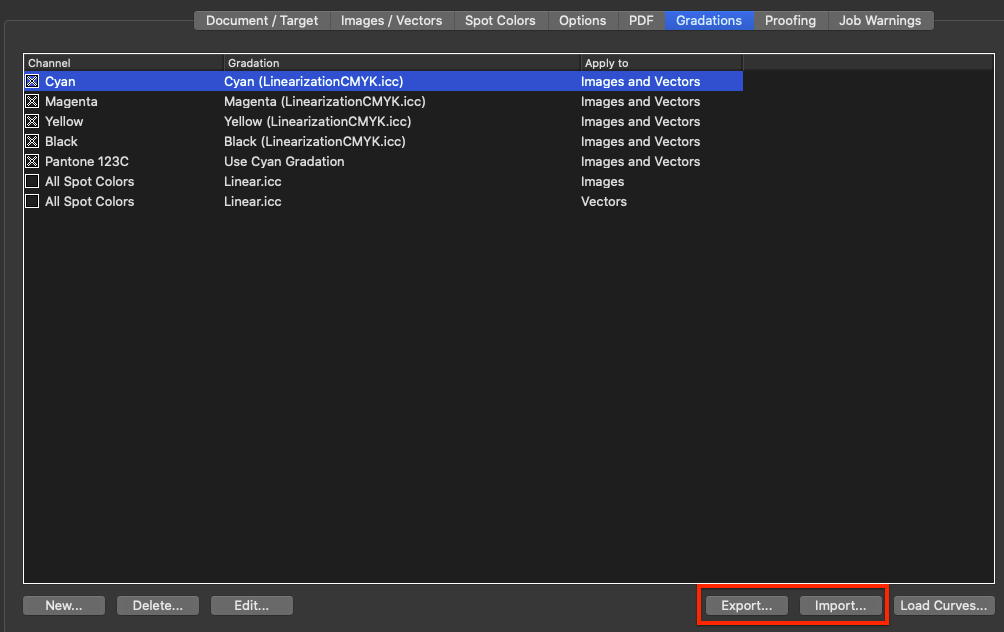
Export and Import: This allows you to export gradation rules from one configuration and import them into another configuration.

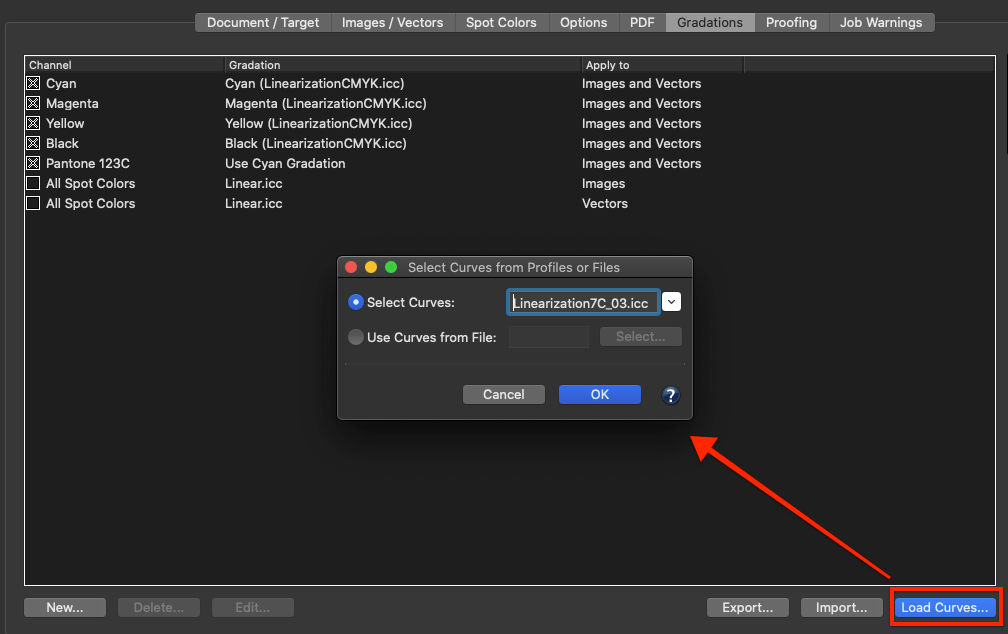
Load Curves: Loads an external file that includes the gradation corrections for the process color(s) to be changed. There are two options to load gradation curves:

  1. Select Curves
    Select linearization DeviceLink profiles created by CoPrA or previously imported files including curves (gradations).
    Gradation curves created with CoPrA’s Linearization tool are saved in the Profiles folder and are automatically listed in ZePrA’s Select Curves drop-down menu. Only curves with a matching color space are shown. These curves are read only and cannot be edited in ZePrA’s Gradation tool. When changing the gradation curves (e.g. by overwriting the .icc file in CoPrA with differing linearization data), these changes will automatically be applied to all configurations using these curves. The location of the selected .icc file is not important (e.g. Profile or Auto Import folder).
  2. Use Curves from File
    Loads external files including the gradation corrections for the curves (gradations) to be changed.
    The curves created with ZePrA or duplicated from imported text files are saved as single-channel ICC DeviceLink profiles in the operating system’s profile folder. In addition to the curves included in ZePrA for tonal corrections from -20% to +20%, the drop-down menu also shows all gray-to-gray DeviceLink profiles located in the operating system’s profile folder. Note that only the curves created in ZePrA can be edited in ZePrA. Write-protected gradation curves can be duplicated and the duplicates can be edited.
    Imported text files are stored internally and temporarily, but not as DeviceLink profiles. These curves are therefore not editable in ZePrA.

Note: Gradation curves created with ZePrA’s Gradations tool are saved in the system folder for ICC profiles and are automatically listed in the Gradation drop-down menus under New/Edit. The curves can also be accessed via Load Curves/Use Curves from File. If you change the gradation curves using ZePrA’s Gradations tool, these changes are automatically applied to all configurations that use these curves.

Importing CTP Compensation Curves

Utilizing ZePrA to automate a workflow using external gradation files and import existing CTP compensation curves or correction gradations into ZePrA, a separate tool will be necessary that calculate the respective correction curves based on measurements on printed sheets and saves them into the following form as text or XML files:

BEGIN_DATA_FORMAT

GRAY    CMYK_C    CMYK_M    CMYK_Y    CMYK_K

END_DATA_FORMAT

BEGIN_DATA

0.00     0.00     0.00     0.00     0.00

1.00     0.69     0.58     0.53     0.65

3.00     2.02     1.76     1.62     1.92

5.00     3.23    2.60     2.38     3.28

10.00     6.95    5.92     5.52     7.41

15.00     10.80     9.64     9.02     11.93

20.00     15.10     13.29     12.43     16.68

25.00     19.53     17.19     16.06     21.52

30.00     24.07     21.88     20.37     26.37

35.00     29.08     26.91     24.94     31.26

40.00     34.12     31.50     28.69     36.24

45.00     39.33     36.43     32.94     41.68

50.00     43.80     41.84     37.96     46.59

55.00     49.20     47.98     43.81     51.42

60.00     55.37     54.01     50.29     57.48

65.00     61.91     60.59     57.36     63.44

70.00     68.46     66.28     63.78     69.11

75.00     74.90     72.54     70.73     74.58

80.00     79.24     78.89     77.66     79.52

85.00     85.08     83.09     82.28     84.93

90.00     89.42     87.13     86.64     89.33

95.00     93.74     92.60    92.40     94.02

97.00     95.66     95.25     95.13     96.03

99.00     98.18    98.01     97.98    98.31

100.00      100.00     100.00     100.00     100.00

In this example, Gray stands for the input values in percent (0-100%) and CMYK_C stands for the output values of the Cyan channel in percent (0- 100%). The example shows a step wedge with 25 gradations of the process colors in CMYK. The number of levels is arbitrary and depends on the measuring wedge.

Note: The curves created using ZePrA or curves duplicated from imported text files are stored as one-channel ICC DeviceLink profiles in the profiles folder of the operating system. The drop down menu shows not only the curves supplied with ZePrA for tone value corrections from -20% to +20%, but all Gray-to-Gray DeviceLink profiles contained in the profiles folder of the operating system. Please note that only the curves created in ZePrA can be edited in ZePrA. Imported text files are stored internally and temporarily, but not as DeviceLink profiles. A separate license is necessary in order to be able to use the Gradation functions. Read-only gradation curves can be duplicated in curve management and these duplicates can be edited.

Automatic Gradation Correction of an Existing Configuration

To furnish existing configurations with the required gradation adjustments using an external file and automate workflows:

  1. Open the Gradations tab in the Define Configurations window
  2. Click the Import button
  3. Select the external file with the required gradation adjustments

In some situations, the format will need to be changed in the Import dialog from configuration file (*.ccf) to text file (*.txt) to be able to import the gradation file. ZePrA assigns the gradation curves found in the file automatically to the right process colors. If spot color curves are also stored in the external gradation file, ZePrA creates the corresponding spot color channel names in the configuration and assigns the appropriate curve to each color. The curve loaded for the selected channel is displayed in a small overview chart.

The configuration is now linked with the external gradation file. If the file is updated because of new measurements on the printed sheet and needs to be overwritten with new gradation curves, ZePrA recognizes the changes and automatically adopts the updated curves.

Gradation curves that originated from loaded text files can be deleted using the Create Gradations dialog. When deleting gradations that are still being used in Configurations, a warning will appear. If this warning is ignored, the gradations in the respective configuration will be deleted and replaced with a linear gradation. Ultimately, when deleting one curve not only the single curve but all curves linked with the file will be deleted.

Applying Gradation Curves to Spot Color Channels

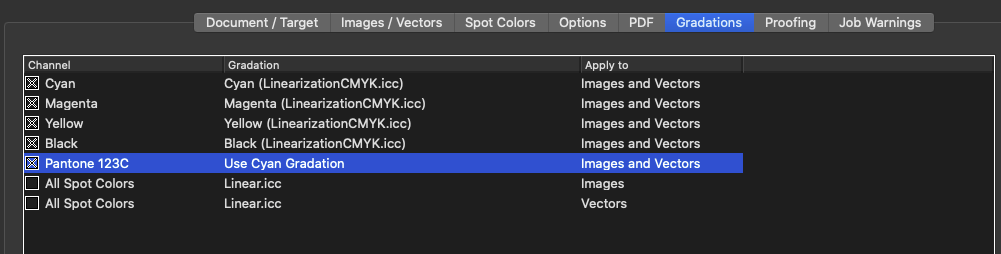
To be able to apply gradation curves to spot color channels, select New and enter the exact name of the spot color. The name of the spot color channel must match the name used for the spot color in the file.

Example:  If the spot color names in the file have different naming conventions, work with wildcard characters when entering the channel name e.g, to process a spot color Pantone 123c or Pantone 123 CVC with the same curve, use the (?) wildcard to replace exactly one number/letter combination behind the wildcard or use the (*) wildcard to replace all combinations. Calling a spot color Pantone 123* in ZePrA will allow the set curve to be applied to spot colors in the document that are called Pantone 123C or Pantone 123 CVC.

ZePrA differentiates between upper and lower case. A spot color created in the documents in all upper case will still be adjusted using the set gradation curve even if it was lower case in ZePrA.

In the Gradations tab, choose from three options to perform a gradation correction for spot colors:

  1. Import existing CTP compensation curves or curves created for gradation correction (read more about this in the chapter Special Settings/Create Gradation Curves). Gradation corrections from an external file may contain more than 16 spot colors and a corresponding number of curves. The XML file format is supported.

Note: If changes are made to the gradation corrections in the external file, ZePrA incorporates them “on-the-fly”. As of now, currently added spot colors with gradation curves are not automatically added in ZePrA. To do this, the file needs to be re-imported.

  1. Select the Cyan, Magenta, Yellow or Black gradation under the Gradation option. Gradation corrections for spot colors are performed with the same dot gains as the color channels Cyan, Magenta, Yellow or Black during conversion from document color space to target color space.

Note: If spot colors are to be preserved and printed as additional channels, then the dot gain must also be balanced out for the spot colors for color conversion from, for example, coated to uncoated paper. If no dot gain measurements are available spot colors, many users use the Black channel as an approximation of the dot gain curve for the spot color.

  1. Standard curves are available with an average TVI value increase of -20% to +20% in 5% increments and all Gray ICC DeviceLinks present. The Gray-to-Gray DeviceLinks permit accurate mapping of a tone value correction curve.

Note: To apply the set spot colors and gradation corrections of one configuration to a different configuration, use the Export button to export all channel names and settings of a configuration. The Import button can be used to adopt an exported setting in a different configuration. Identical channel names are overwritten when importing.

ZePrA | Configurations | PDF

PDF

Define Settings for PDF Processing

Define Settings for PDF Processing

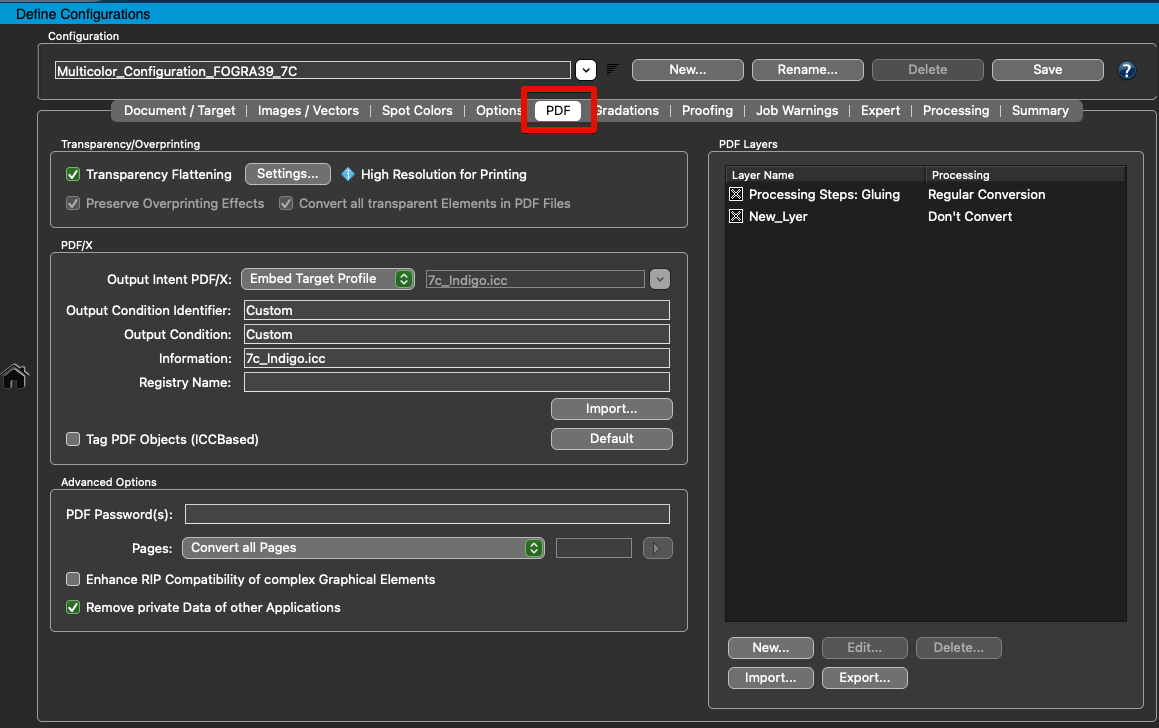
In the Configurations/PDF tab, Transparency/Overprinting, PDF/X-specific information, Advanced Options and PDF Layer rules can be defined.

PDF/X-specific information is recommended when ZePrA is used to create the print data. The print shop receiving the PDF/X data can determine from the PDF/X entries for which print standard the PDF/X files have been optimized.

ZePrA supports the following PDF/X standards:

  • PDF/X-1a
  • PDF/X-3
  • PDF/X-4
  • PDF/X-5n

Transparency/Overprinting

PDF/X

PDF/X-specific information is recommended when ZePrA is used to create the print data. The print shop receiving the PDF/X data can determine from the PDF/X entries for which print standard the PDF/X files have been optimized.

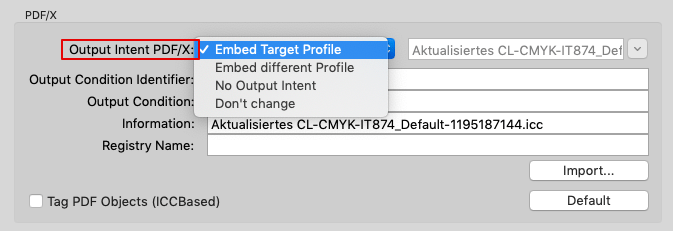
PDF/X Output Intent: The output intent is a color profile containing the printing color space for which the PDF file was created.

Four presets are available in the drop-down menu:

Selection of the PDF/X Output Intent


Embed Target Profile: The default setting. The target profile is embedded as output intent

Embed different Profile: A manually selected profile is embedded as output intent

No Output Intent: Removes the output intent

Don’t change: Output intent remains as is.

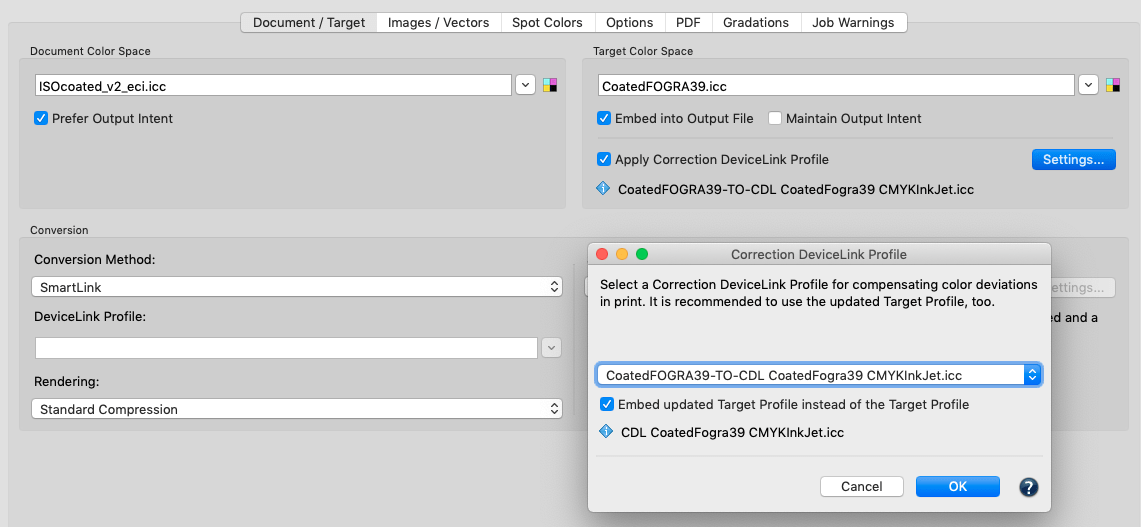
Note: If a Correction DeviceLink Profile has been selected in the Document/Target tab under Target Color Space and the checkbox Embed updated Target Profile instead of the Target Profile has been activated under Settings, then this corrected target profile is embedded as output intent.

Output Condition Identifier: Indicates the color measurement data on which the color profile of the output intent is based. This information is important because there are profiles with sometimes quite different names for print standards from different providers. If a print shop receives PDF/X data from users who work with different profiles, it can use Output Condition Identifier to determine whether it is a profile for an industry standard or a custom profile.

Output Condition Identifier: Enter the description of the printing standard for which the PDF/X data was optimized.

Information: Customer, job, printing process or file specific entries can be entered here.

Registry Name: At www.color.org the ICC maintains a registry for colorimetric data and output conditions representing international printing standards. If a print shop works with many different suppliers, it is advisable to agree on a name/output condition identifier registered with the ICC.

Import: When a PDF/X file is loaded using Import, ZePrA extracts the PDF/X information it contains. It is then no longer necessary to enter the information manually.

Note: When using ColorLogics DeviceLink Sets with the extensions CoLoV3/V4/V5/V6, they contain information that is automatically entered in the corresponding fields for PDF/X information in ZePrA. When creating Queues with Auto Setup, no manual entries in the PDF/X information are necessary when using ColorLogic DeviceLinks. Similarly, no manual entries are necessary when working with a target profile that ZePrA recognizes as a standard output profile.

Note: For custom DeviceLink profiles, CoPrA's Profile Manager tool allows to make the entries required for automatic transfer of PDF/X information to ZePrA very easily in the Workflow tab.

Tag PDF Objects (ICCBased): Assigns the target profile to each object in the PDF file after color conversion. Can be used if a PDF file is not a PDF/X file, but you want to ensure that the color information for images and vectors is correctly defined with the target profile. By default, this option is disabled and we recommend using it only when necessary.

Advanced Options

PDF Passwords: Passwords in PDF files prevent data from being converted. Enter the password to remove the password protection and to enable conversions.

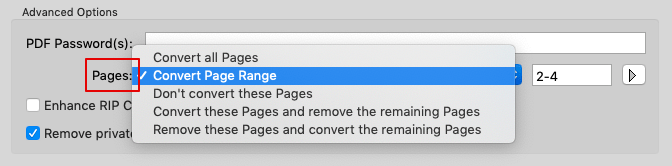
Pages: Specifies which pages are converted for PDF files with multiple pages. Pages can be selected individually if they require different color conversions.

Selection of pages to convert


Convert all Pages: The default setting. Converts all pages of the PDF document

Convert Page Range: Converts specific pages of a multi-page PDF document. Enter the relevant page numbers or range. Multiple page numbers are separated by commas (for example 3,5,8), page ranges are hyphenated (for example 5-9).

Don’t convert these Pages: Converts all but selected pages.

Convert these Pages and remove the remaining Pages: Extracts and converts the specified pages. The remaining pages are removed.

Remove these Pages and convert the remaining Pages: Removes the specified pages. Converts the remaining pages.

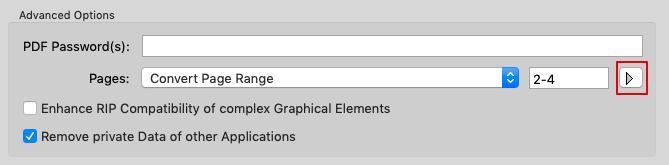
Additional page selection rules can be selected by clicking the arrow button

zepra5_pdf-advandedpageoption2

Enhance RIP Compatibility of complex Graphical ElementsZePrA converts all objects, including vector shading, with high accuracy and 16-bit precision. For every shading created based on a function in the original file, it is necessary to use a very large LUT (look up table) to ensure a correct color transformation.

Some RIPs (e.g. EFI Fiery and Global Graphic Multi RIP) have issues in handling 16-bit shading and large LUT’s. To avoid issues and to speed up processing time of certain RIPs, the option Enhance RIP Compatibility of complex Graphical Elements can be used. This option is disabled by default in all existing configurations and for all new configurations created using the Auto Setup Wizard. Activate this option whenever processing issues with a RIP occur after converting files with ZePrA.

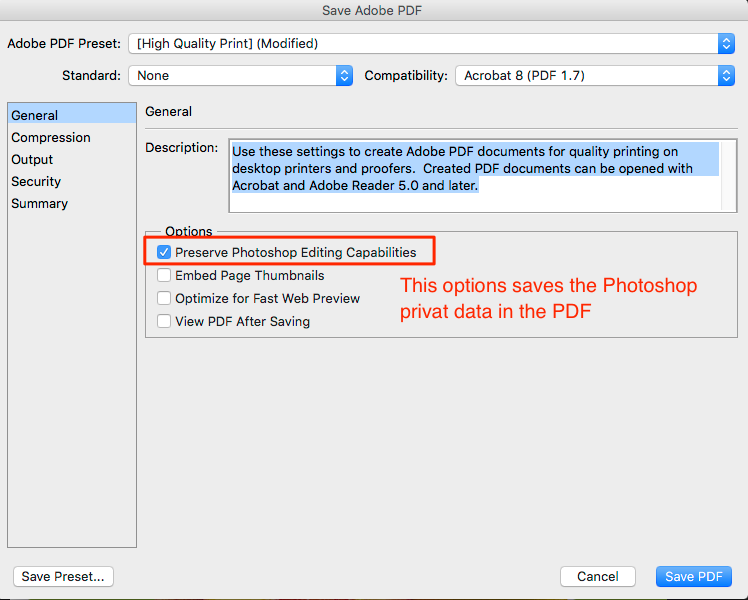
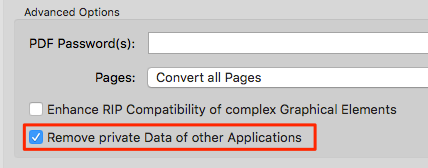
Remove private Data of other Applications: Removes private application data from PDF files. Such data can be stored optionally by Adobe Photoshop or Illustrator when saving files as PDF.

However, other programs can use so-called “piece information” in PDFs as well to place non-public application data in PDF files. This allows the subsequent opening and editing of the original file in the previously mentioned applications. However, for color converted files this application data can be misleading as it will not be converted. Reopening these files in the above mentioned applications will then only display the original but not the converted color information. Additionally, PDF files which contain piece information can be significantly larger. To obtain smaller files (without piece information after conversion of PDF files) select the function Remove private Data of other Applications.

PDF Layers

ZePrA 7 and higher supports ISO 19593-1:2018 (Processing steps for packaging and labels). It is common practice in the packaging segment and other segments of the printing industry to work with PDF files that contain graphic objects to be printed and additional graphic objects and metadata for use in other steps in the production of the final product. These non-printing PDF objects and metadata are important for processing steps like die cutting or creasing.

Definition of processing step: Step in production of print products other than regular printing of color on the print surface. Example: Cutting, printing of white, varnish or similar. A layer is recognized as a processing step by its metadata in the layer dictionary of the PDF ("optional content group"). The feature also works for layers which are not covered by the "Processing Steps" standard. In this case, the layer name is specified by the user.

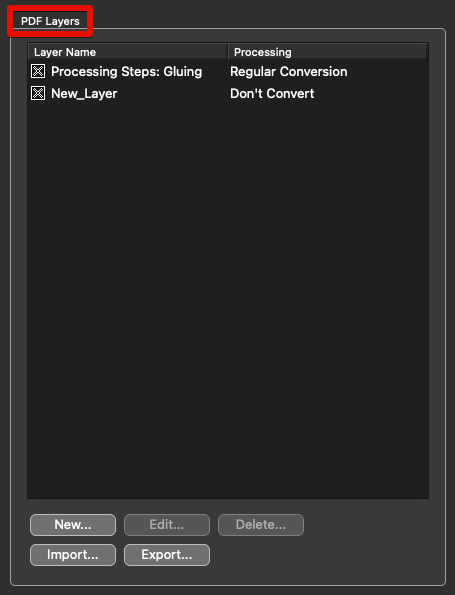
The PDF Layers feature allows you to define rules which specify how individual layers are processed. When applied to PDF files, only the content of selected layers can be converted, while the content of unselected layers remains untouched or can be deleted.

Export and Import: These functions allow you to export rules from a configuration and import them into another configuration.

Procedure

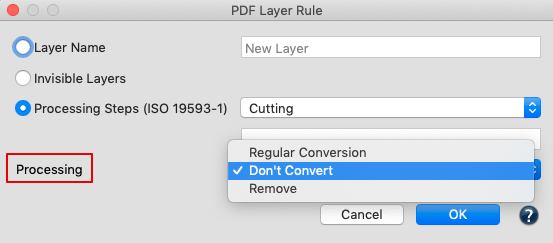
Double-clicking a rule or hitting New opens the PDF Layer Rule dialog. Each rule specifies the processing of the selected layer(s). The following options are available:

Layer Name: Enter the name of the layer to be associated with a Processing option. Layer names may contain wildcards, e.g. * means all layer names.

Invisible Layers: Selects all layers which are switched off and are therefore invisible in PDF viewers such as Acrobat.

Processing Steps: Defines layers which are marked as Processing Step according to ISO 19593-1. The processing step type can be chosen from the menu. All means all processing steps. Custom means a processing step name as specified in the text field.

Processing defines how a selected layer is to be treated:

  • Regular Conversion:The layer is converted as usual.
  • Don't Convert: Excludes layer from the color conversion.
  • Remove: The layer is removed from the converted PDF file.

General considerations

  • In PDF files, graphical elements can be associated with any number of layers. For each element, ZePrA searches the list of layer rules from top to bottom for a rule that matches the layer name of that element. The first matching rule found will then be applied. Subsequent rules will be ignored, which means, that only one rule is applied to each graphical element.
  • If an element is associated with more than one layer and there are several matching rules for these layers with different processing options, for example, if the first layer is set to Don't Convert and the next is set to Remove, the result depends on the order in which the rules appear in the list.
  • Make sure to list layer rules in an appropriate order in ZePrA. Open the context menu and use Cut to cut a layer, select a different position of the mouse and Paste to change the order of rules at any time.
  • Layers set to Remove will be removed from the OCProperties list and  will not appear in the layer panel of Adobe Acrobat.
  • Spot color conversion for spot colors which were removed with layers do not appear in the job report.
  • When a file is flattened, it's layer structure is destroyed. Therefore, to preserve a layer, ZePrA extracts it from the PDF before flattening and merges it thereafter.
  • A potential special error can occur when layer rules preserve  layers that are merged at the end of the painting order. This means if in the original file a part of a preserved layer is covered by another element which is painted later, this layer is no longer covered in the converted file. Currently, there is no solution for this problem, on the other hand it might be of no importance in practice.
  • ZePrA can rasterize a file to PDF while retaining the layers. The result is a single image containing the rasterized document with the layers on top.

ZePrA | Configurations | Spot Color

Spot Colors

Customize spot color conversion

Spot Colors

ZePrA’s Spot Color module offers the most accurate methods for converting spot colors of PDF files into CMYK, RGB or Multicolor color spaces. It requires a spot color license which is included in ZePrA XXL but it is also available as add-on module.

The Spot Color module

  • is part of ZePrA XXL, including a Multicolor license
  • can be obtained as add-on for ZePrA (requires a spot color licence)
  • is part of the Multicolor add-on (requires a Multicolor licence)

How to achieve the best possible printing results:

  1. Create a Spot Color Library. For best results, try to match and measure color values of spot colors as closely as possible based on either the printing process or a proofer, or based on the requirements of the customers. The more complete a spot color library, the better ZePrA can automatically color convert spot colors of PDF and image files into the target color space. The spot color libraries in ZePrA contain fundamental descriptions of the spot colors, e.g., measured values of the solid tone and tints (gradations), measurements on white and black, opacity and information as to whether they are non-printing channels, such as cutting marks, register marks or the like. Further information is available under Global Settings/Spot Colors.
  2. As an alternative to separate spot color libraries, CxF/X-4 spectral data for spot colors can be included and travel with the PDF files. ZePrA can take advantage of this information and can be set to prefer this dynamic data over the library. Read more below under Spot Color Libraries.
  3. Apply the spot color libraries or CxF/X-4 data of the configuration to the PDF and image files. In the Configuration/Spot Colors dialog, specify how spot colors are to be converted into the target color space. All configurations receive these fundamental descriptions from the Spot Color Libraries to determine the most accurate Lab or spectral values.
Converting spot colors in pixel based formats: Spot colors from image files (ZePrA supports TIFF, PSD and PSB pixel formats) can be converted by creating the spot colors as alpha channels with spot color attribute.

Without spot color module: The alternate color space colors indicated in the PDF file are used to convert spot colors to the target color space which results in inferior quality. Read more below under Working without the Spot Color Module.

Note: In many cases, standard conversion without using a custom spot color library does not result in sufficiently good rendering of the spot color, nor does it produce a substitute process color that prints well.

Retaining user defined spot colors: Retaining user defined colors is critical to print production. This is required in packaging printing, for example, when areas for punch marks, braille, varnish, folding and trim marks are to be retained.

Converting Spot Colors

Spot color objects can be converted into CMYK, RGB or Multicolor. For example, spot colors will be converted into CMYK if the target profile defined in ZePrA is a CMYK profile.

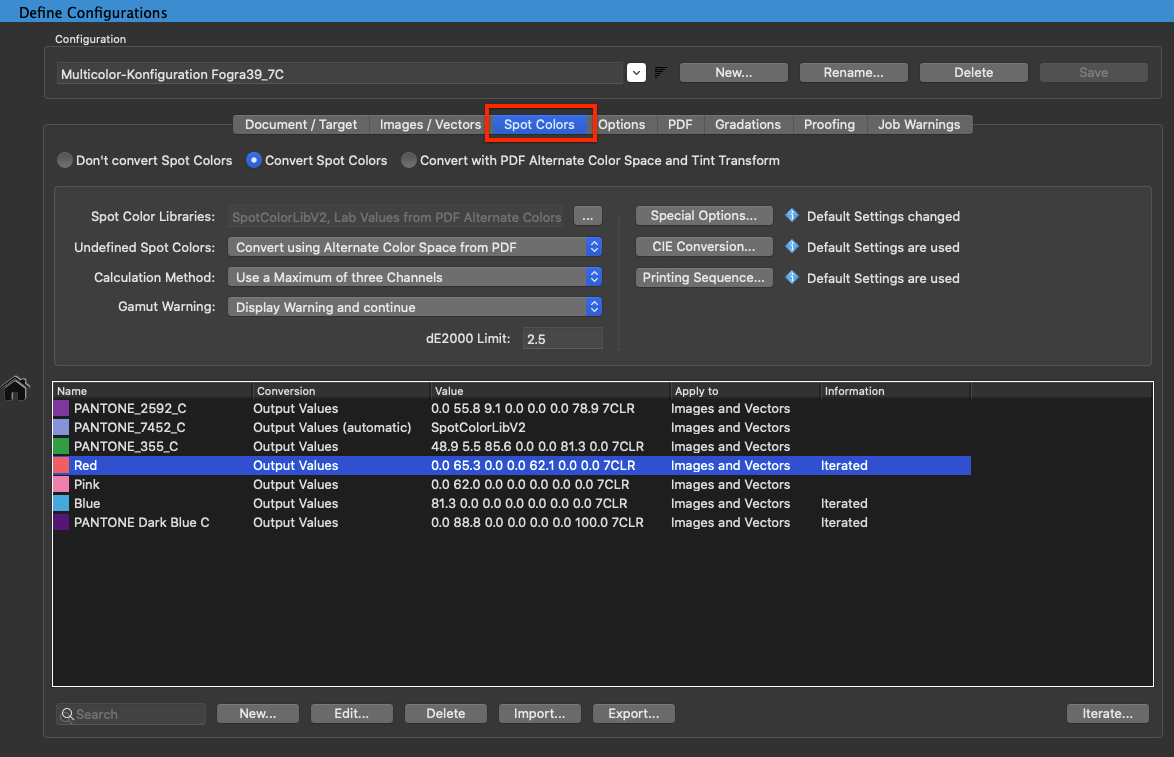
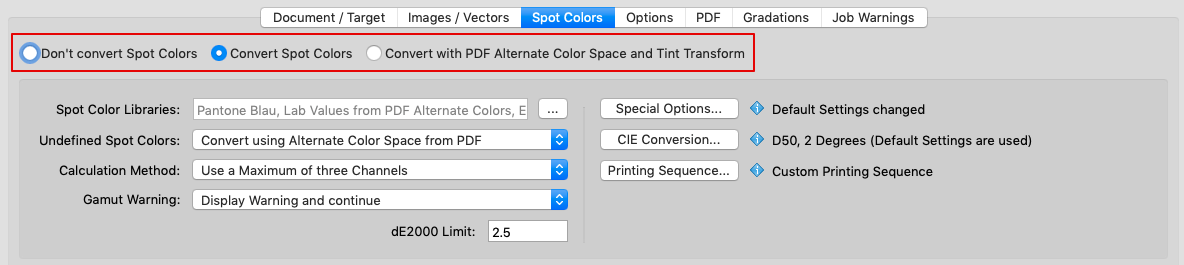
There are three options to process spot colors:

  1. Don’t convert Spot Colors: All spot color objects remain unchanged. If necessary, use the Gradations function to make additional tone value corrections to spot color gradients.
  2. Convert Spot Colors: Spot colors are converted to process colors. For example, in digital printing spot colors have to be converted.
  3. Convert with PDF Alternate Color Space and Tint TransformUses the alternate values (Alternate Color Space and Tint Transform) stored in the PDF for the respective spot color. This results in a much lower quality reproduction than when using a spot color library with spectral data and gradients and the ColorLogic calculation methods. This option is used for comparison with results obtained by PDF viewers and preflight tools if spot color conversions were performed with them.
    Note: The high-quality ColorLogic calculation methods are not used in this case.

All following steps require the spot color module.

Convert to Target

Under Define Configurations/Convert Spot Colors to Target Color Space, spot-color objects are converted into CMYK objects if the target profile is a CMYK profile. Use the Convert Spot Colors to Target Color Space option if spot colors are not wanted in the final print job.

If the Convert Spot Colors to Target Color Space option is not activated, all spot-color objects remain unchanged. If necessary, use the Gradations function to make additional tone value corrections to spot-color gradients.

Spot Color Libraries

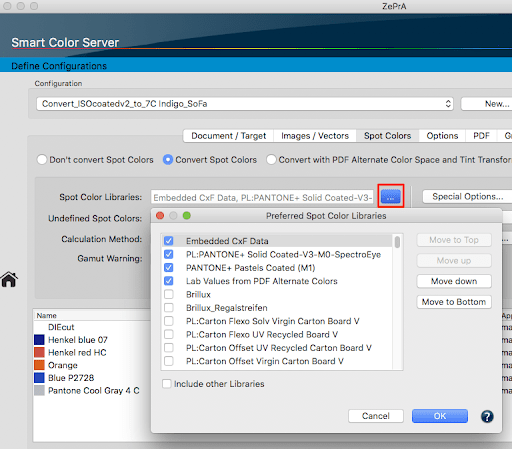
Select the spot color library or multiple libraries that should primarily be used to perform the conversion. Spot Color Libraries can be selected using the button to the right of the library display.

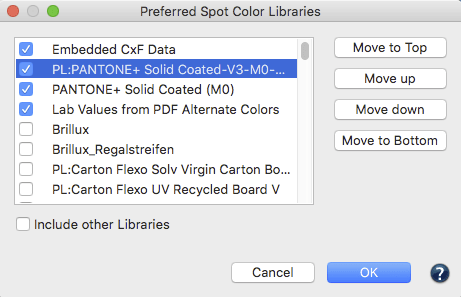
Preferred Spot Color Libraries: Select a single or multiple spot color libraries.

Include other Libraries: Searches other libraries for matching spot color names. The default use of this option is not recommended because there is a possibility of automatically selecting a spot color from a library that does not match the capabilities of the target printer.

Example: If one of the spot color libraries contained a spot color that was printed on OPP film, but the target profile was printed on paper, it would not match. Therefore it is recommended, to manually select those libraries that fit the printer’s requirements.

Prioritize Spot Color Libraries

The top library has the highest priority, the others are considered in the order from top to bottom. The order of the selected libraries can be changed with the buttons Move up, Move down, Move to Top, Move to Bottom.

Move to Top: Moves the selected spot color library to the top of the list.
Move to Bottom: Moves the selected spot color library to the bottom of the list.

Further Options for Spot Color Conversion

Embedded CxF Data: Automatically uses any available CxF/X-4 spectral data for spot colors in PDF/X files. CxF/X-4 has been an ISO standard since 2015 and has been designed to define spot colors by measuring and storing spectral information of ink solids and tints, on substrate and process black. This spectral definition allows color management systems like ZePrA to better proof and reproduce spot colors.
Note: With ColorAnt L (from version 5), CxF/X-4 data can be embedded in PDF/X files.

Lab Values from PDF Alternate Colors: Uses the alternative Lab color space instead of a library. Newer versions of Adobe InDesign save Lab PDF replacement color values instead of CMYK in the PDF file. If spot colors do not have CxF values or are not available in a spot color library, you can use the alternate Lab value from the PDF file.

Note: If the alternate color space in the PDF file is not Lab but, for example, a CMYK color space, it will not be used and will be considered undefined by ZePrA.

Undefined Spot Colors

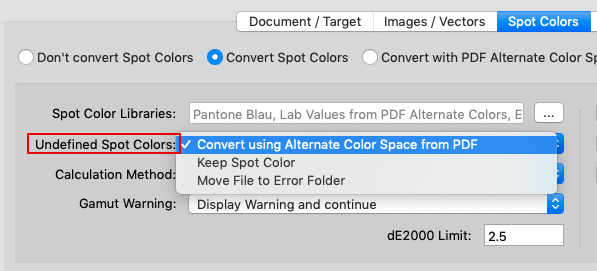
Defines how spot colors that are neither contained in a library nor defined in the lower table of the Spot Colors tab are to be converted.

  • Convert using Alternate Color Space from PDFUndefined spot colors will be converted by the possibly less accurate alternate color stored in the PDF, which may lead to poorer quality results.
    Note: The high-quality ColorLogic calculation methods are not used in this case.
  • Keep Spot Color: All undefined spot colors are preserved and not converted.
  • Move File to Error Folder: If an undefined spot color is found, ZePrA displays an error message for the corresponding job on the Overview page. The file is moved to the Error folder of the corresponding queue.

Note: Files can contain multiple undefined spot colors, even if only one is displayed in ZePrA’s Overview.

Calculation Method

The Calculation Method specifies how a spot color, a combination of spot colors and process colors, or multiple spot colors are converted to the target color space.

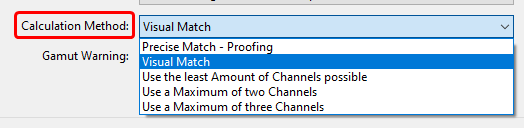
The following Calculation Methods are available:

  • Precise Match – Proofing: Reproduces spot colors on a proofing printer as precisely as possible. This method is not meant to be used in production as it may use all process colors to achieve the closest match (based on DeltaE 2000). The full tone is calculated with the aim of generating the smallest possible DeltaE 2000 value. No channel reduction or print optimization is applied.
  • Visual Match: The visually best conversion with high colorimetric accuracy and good printability. Solid tones are converted with the fewest number of channels that are absolutely necessary for good colorimetric accuracy. Channels will be reduced or clipped to 100% if the deltaE increases only slightly compared to the proofing method. Single-color and two-color combinations are also included in the search for the best color combination. Tints may be rendered with more channels than the solid tone if needed for a good match. Spot colors that are present in combination with process colors or other spot colors may consist of several process colors after conversion. This option is suitable for digital printing, large format inkjet printing or offset printing with a fine screen ruling.
  • Use the least Number of Channels possible: Converts spot color solids and tints with the least number of channels and still delivers colorimetrically acceptable results. In rare cases, for some dark solids, up to four channels can be used to achieve a good match. Single-color and two-color combinations are also included in the search for the best color combination. Usually, three or fewer channels are used to render spot colors. Typically, tints are rendered either with the same channels used for the solid, or with one channel more if needed for a better match. After conversion, overprinting spot colors consist of as few process colors of the target color space as possible. Choose this method for packaging printing, where the purest possible colors are to be produced.
  • Use a Maximum of three Channels: This method is similar to the calculation method Use the least Number of Channels possible, but ensures that no more than three channels are used. Tints also use a maximum of three channels. Choose this method for packaging printing, where the purest possible colors are to be produced and no more than three process colors for spot color conversion may be used, even if that results in a less accurate match. Single-color and two-color combinations are also included in the search for the best color combination.
  • Use a Maximum of two Channels: The conversion is limited to the use of only one or two process colors selected for each spot color. Tints use a maximum of two channels as well. This results in very clean separations that are easy to print, but not necessarily very accurate in colorimetric terms. It is recommended to use this function only for single spot colors and not generally for all spot color conversions.

ZePrA converts spot colors automatically visually and print optimized (channel minimized). A visually optimized conversion will prioritize the lowest visual color difference based on ColorLogic’s own DeltaE method.

This may result in more process colors being used to simulate the spot color. Our channel reduction method prioritizes the use of as few channels as possible while maintaining a low DeltaE 2000 value. Channels will only not be used if the resulting color is still close to the original spot color.

Note: ColorLogic’s own DeltaE methodology is very close to DeltaE2000 but is more suitable in certain areas, especially for larger color differences for which DeltaE2000 has proven not to be well suited.

Gamut Warning

The Spot Color module delivers extremely accurate color rendering in the conversion of spot colors to process colors. However, it is possible that some spot colors are outside the printable gamut of the target profile and thus prevent precision rendering. In this case, a deltaE Limit (dE 2000) can be set under Gamut Warning to receive a warning message.

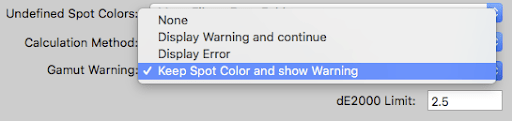
 Choose a Gamut Warning

None: No warning or error message during spot color conversion to the target color space.

Display Warning and Continue: Displays a warning if the specified dE2000 Limit is exceeded during the conversion of spot colors to the target color space. The processed file is also highlighted in yellow in the Jobs and Queues Overview. The file is then converted and moved to the Output folder.

Display Error: The file is not converted and is highlighted in red in the Jobs and Queues Overview. Subsequently it is moved to the Error folder.

Keep Spot Color and Show Warning: The spot color causing the warning will not be converted and is preserved. All remaining spot colors will be converted. The converted file is highlighted in yellow in the Jobs and Queues Overview and is moved into the Output folder or the Warning folder (if this folder has been created in the Queue settings).

Note: Gamut warnings for spot colors can be disregarded. See details under Edit Spot Color Conversions.

Special Options

The Special Options button opens a dialog for specifying the Merging Color Space, the Linearity of tints and other general conversion settings. When using default settings, the message Default Settings are used is displayed next to the Special Options button in the Spot Colors dialog.

Merging Color Space: Defines the color space to be used for overprints and tints calculation. While spot colors are always converted to the ICC profile defined as Target Color Space the overprints and tints could either be assumed to simulate the Document or the Target Color Space. The following options are available in the drop-down menu:

  • Automatic (default): Uses mostly the profile defined as target color space but the document color space is used if an RGB working space profile is selected as target profile (see Example 3 below).
  • Target Color Space: Uses the target profile for all overprint and tints calculations. Example: Typical production printing with spot colors converted to the target color space.
  • Document Color Space: All calculations use the document profile.
    Example 1: In proofing we want to inspect how ISO coated V2 and two spot colors interact visually (overprints of the spot colors with CMYK) and not how the two spot colors are overprinting in the proof printer's profile.
    Example 2: If the target profile is an RGB inkjet printer for production printing we would nonetheless pick spot color properties from a reference data or reference profile (document color space) instead of the target profile.
    Example 3: For soft proofing of a CMYK+Spot Color file we do not want to see the tints and overprints in the RGB monitor color space (or AdobeRGB etc.). Instead, we want to see how the gradations and overprints would look like if printed together with CMYK (document color space) and that should then be rendered to the RGB monitor color space.

Linearity: Defines how tints of spot colors are calculated. This is especially important if there are no tints available (no measurements on white background) and only the full tone of a spot color is defined. The following options are available in the drop-down menu:

  • Automatic: If the tints of a spot color are available (measurements on white background) then they will be used as target values. If only the full tone of a spot color is defined, the average linearity of the corresponding ICC profile will be used. The profile to be used depends on the Merging Color Space setting.
  • Use ISO 20654 (SCTV) for all Tints: Uses the ISO method to calculate the linearity of all tints. This option forces SCTV linearity, even when tints are included in either the ZePrA’s spot color library or embedded as CXF/X-4 in the job. If the spot color library or CxF/X-4 data contains tints, the hue of the tints is still preserved in the calculation, but the linearity is calculated according to ISO 20654. Consequently, this option adjusts the linearity derived from the measurements of the tints to the linearity according to ISO 20654.
    Note: Use this option if you want to overwrite the linearity and use SCTV consistently for all spot colors even those where tint measurements are available that deviate from SCTV.
  • Use ISO 20654 (SCTV) for undefined Tints:
  • This is the default Linearity setting. It improves the overall rendering of tints when only the full tone is specified. In the process, the SCTV linearity curve is applied to spot color tints for which no tint measurements are stored in ZePrA’s spot color library.
    When tints are available, ZePrA uses this information to render the tints (e.g., if CxF/X-4 measurement data is available for a spot color, or if the used spot color library contains measurements of spot color tints on white background).
    Note
    : This is the recommended option as in many cases no measurements of the tints are available. However, if these tints and the associated linearity are available, they will be used.
    For existing configurations (ZePrA 11 and below) where the Linearity has not been explicitly specified, this setting is adopted. This affects configurations which have been created via the Auto Setup Wizard and have not been edited afterwards. However, if the Linearity has been changed manually and then set to Automatic again, this setting is fixed and will be retained in the configuration.

Avoid Dot-on-Dot CombinationsActivating this checkbox prevents process color combinations that could produce Moiré effects in AM printing such as Cyan and Orange, Magenta and Green or Black and Violet.

Example: If the target color space is a Multicolor profile and printing is done with AM screening then mostly Cyan and Orange, Magenta and Green and Black and Violet are on the same angles which might produce Moiré or other dot-on-dot effects if printed together.

Enabling the checkbox prevents the typical color combinations listed above, therefore preventing Moiré or other dot-on-dot effects. However, if disabled, the spot color conversion can use any combination of process colors.
Note: Enabling the checkbox may reduce the ability for a perfect color match.

Prevent the Use of more than one Gamut Extending Color when converting spot colors: This feature helps to avoid mottle issues when two or more extended gamut inks are printed together.

Note: Using that option might limit the accuracy of spot color rendering in certain cases.

Don’t convert Spot Color "All"Register marks and other black printer marks are often created with the specific spot color “All”. In order to avoid conversion of this specific spot color to the target color space, activating the option Convert Spot Colors will automatically activate the checkbox Don’t convert Spot Color “All”.

Clip Output Values below (0-20): Specifies the minimum tone value for spot color conversion of the full tone. This feature is particularly relevant for flexographic printing.

Example: If process colors below 3% are printing unstable, enter 3 as the threshold value. ZePrA will then avoid generating process colors for converted spot colors below 3% and will instead calculate alternative process color combinations. However, setting the threshold value too high may result in a deterioration of the DeltaE value.

Note: Tone values of process colors that are below the defined threshold can still appear in the file to be converted, if light gradation values of the spot color are present (e.g. 20%). If this is not desired, it can be resolved with an additional gradation curve that clips these color values. Such a gradation curve can be created in the Gradations tool and applied in the Gradations tab in the Configuration.

Black Start: Defines the starting point for using black in spot color conversions.
Note: When converting spot colors to process colors, usually black is used whenever possible. However, in some applications this can lead to peppering effects for light colors using low resolution printing. In this case a late black start will use more of the other process colors and with a very late black start (e.g. setting 100%) it can be forced to use no black at all in the process color build. The use of very low values (below 10) is not recommended.

Prefer CMYK up to an additional dE00 Value of: This function allows spot colors to be converted to the CMYK components of a Multicolor profile even if the combination with other gamut extending process colors is equally possible, or even if less process colors would be used. By default, the same internal deltaE00 tolerances that are used for the selected Calculation Method are applied here, hence the Prefer CMYK up to an additional dE00 Value of input field is empty. If you would like to allow a higher tolerance for the use of CMYK builds you can enter an additional dE00 value.
Note: This value is added to the dE00 match of each spot color for the various Calculation Methods, hence it is recommended to use only a small value such as 1 to 3 to avoid rendering the spot colors with an overall dE00 threshold that is too high.

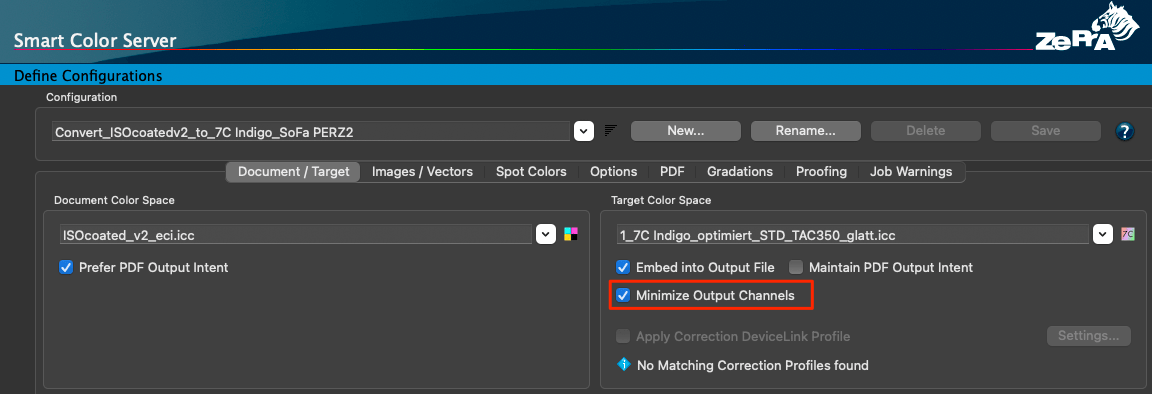
Tip: We recommend enabling the Prefer CMYK feature when using the Minimize Output Channel option.

Note: Custom values entered under Clip Output Values below, Black Start or Prefer CMYK up to an additional dE00 Value of are preserved even if the checkbox is unticked and the number field is grayed out. This is useful when testing an option with a custom value.

Printing sequence

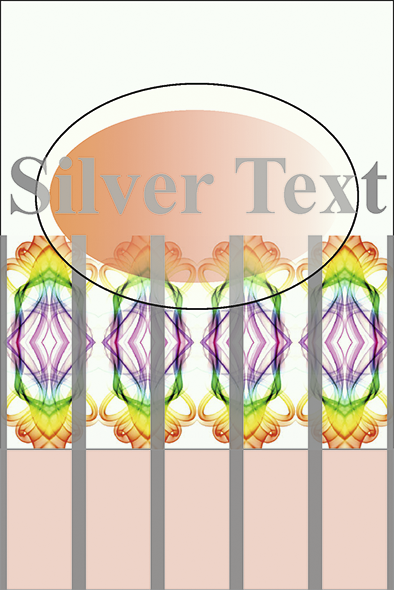
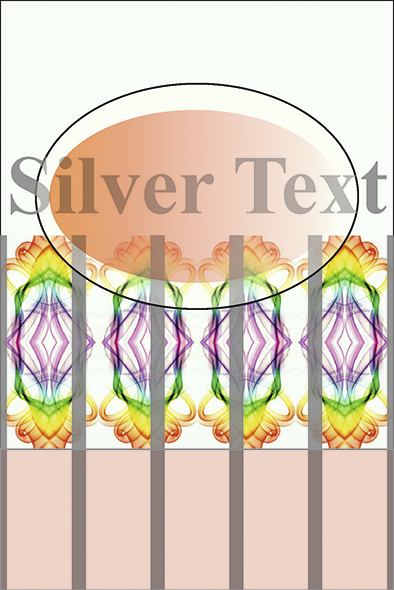
The printing sequence plays an important role when converting spot colors. For example, there is a difference in the color reproduction depending on whether the spot color Silver is printed on top of or underneath the spot color Orange as shown in the two examples below (left: Silver on Orange, right: Orange on Silver).

Another aspect that needs to be considered in regard to the printing sequence of transparent spot colors is the opacity of a color (see the opacity description under Edit Spot Color). If transparent spot colors are to be converted into process colors, ZePrA automatically considers the opacity and the printing sequence of spot colors.

The Printing Sequence dialog offers several options to define the sequence of spot colors according to your printers requirements. Only refers to spot colors. Process colors such as CMYK or the channels of a Multicolor target profile cannot be defined here.

  • The PDF specification allows the printing color sequence to be saved in the PDF file. If the printing sequence is correctly defined in the PDF file and the checkbox Use Printing Sequence from Document is enabled, ZePrA uses this information without the need to manually bring all of the spot colors into the right order. Please note that this feature is rarely set or used correctly by PDF-creation programs. If enabled it overwrites the three options below and uses the document settings. However, in case document settings are not available, one of the following options will be used:
  • Dark -> Light: Automatically sorts all spot colors from the dark to the light L* values. This is a typical ink sequence setting in Flexo and Offset printing and the default setting in ZePrA.
  • Light -> Dark: Automatically sorts spot colors from light to dark L* values.
  • Custom Printing Sequence: Works in combination with the Add and Delete buttons below the table. Add the names of the spot colors and arrange the desired printing sequence from top to bottom using the Move up and Move down buttons.
    Note: A minimum of two spot colors must be defined in order to be applicable.

ZePrA can only interpret the printing sequence of PDF files correctly, if objects consisting of several spot colors and/or process colors have been created together in one DeviceN object - see also Dissolve Overprinting under Transparency/Overprinting.

Note: The printing sequence of spot colors in image files such as PSD or TIFF files is determined by the order of their appearance in the channels panel, with the topmost channel printing as the topmost spot color. Therefore the settings of the Printing Sequence dialog have no effect on image files.

However, the printing sequence for images can be defined in Photoshop:

  1. Select the Channels tab (in Photoshop)
  2. Arrange the channels manually in the required order
  3. Save the Photoshop file with the custom channel order and use it in ZePrA
CIE Conversion

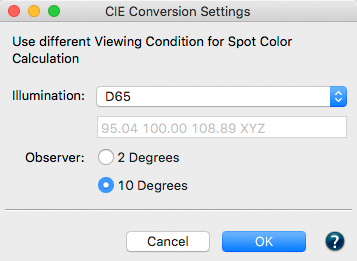
The CIE Conversion is very useful for special applications such as textile printing. In the textile industry the standard illumination is D65 and the standard observer is 10 degrees.

The Lab values used for conversion can be changed by selecting the desired Illumination and Observer settings. Changes only apply to spectrally defined spot colors and are only useful if the target profile was created with a matching illumination and observer.

zepra5_config-spotcolor-illumination

Note: The default setting is D50 and 2 Degrees.

Typically, printer profiles are optimized for D50 viewing conditions, however, for different tasks, e.g. photos in a gallery under incandescent light (roughly corresponds to viewing condition A) or presentation displays under a trade fair lighting with suboptimal lighting conditions (e.g. fluorescent light), the lighting conditions can be taken into account when creating the profile.

To do so, select one of the three predefined viewing conditions or manually enter the measured viewing condition as Kelvin value or as XYZ value.
Alternatively, simply drag and drop a measurement file (TXT or CSV file) of the measured light onto the value field. ZePrA extracts the white point from the file and displays the value.

To select a spectral light measurement select the entry Emission in the drop-down menu Illumination and then select your measurement data file in the subsequent dialog or just drag and drop your measurement data file onto the drop-down menu.

Edit Spot Color Conversion

Individual spot colors can be adjusted within a Configuration. This feature allows to apply specific rules to a spot color which is then handled differently from the general setting defined for spot color conversion.

This tool is also useful to check the conversion outcome and DeltaE results of a single spot color. Spot color rules listed in the table can be edited or deleted.

Creating New Spot Color Rules

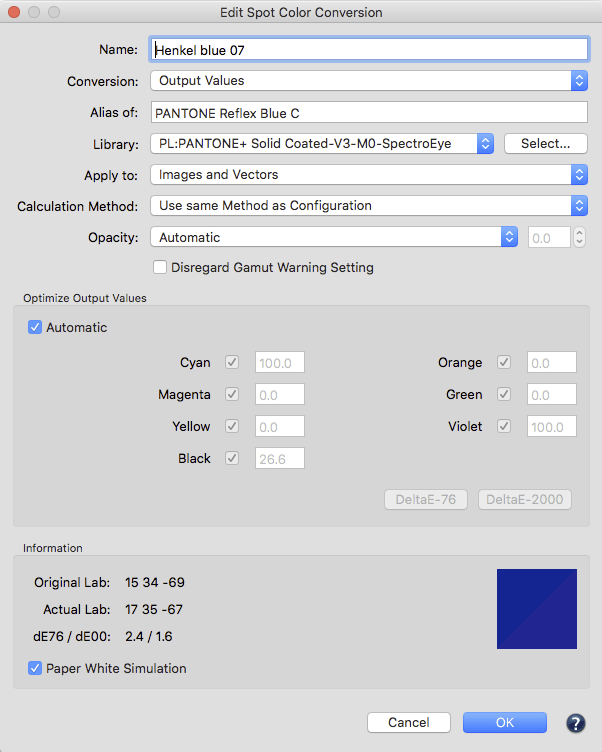
Click New to open the dialog Edit Spot Color Conversion and select the spot color to be adjusted by entering the Name of that spot color.

Detailed processing settings for a spot color

When the spot color is displayed:
If the spot color is available in the color libraries under the name entered, the names of the libraries are displayed next to Library, and the Lab color value together with a true-color preview of that spot color is displayed in the Information section underneath.
If several libraries are shown, the same spot color name exists more than once and you need to choose the correct Library for this configuration.

If the spot color is not displayed:
If the spot color is not available in the color libraries, the drop-down menu Library remains disabled.
Tip: Check the spelling of spot color names. Check upper- and lower-case characters and use wildcards. Underscores in name elements are interpreted as spaces.

Use of wildcards
If identical spot colors have different names, work with wildcard characters when entering the channel name. For example, to process a spot color named Pantone 123c or Pantone 123 CVC with the same library, use the (?) wildcard to replace exactly one number or letter combination behind the wildcard or use the (*) wildcard to replace all combinations. Entering Pantone 123* refers to spot colors named Pantone 123C or Pantone 123 CVC.

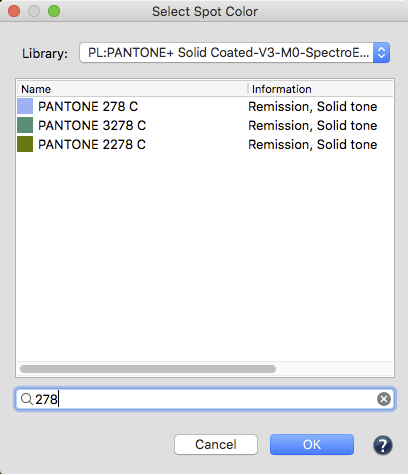
Alias ofIf the spot color name was not found (for example because you have used a wildcard), specify an Alias. To do so, click the Select button next to Library. The Select Spot Color dialog opens. Select the desired Library and all spot colors of that library will be displayed.

Select the name of the spot color and click OK.

Tip: Use the search field below the table to simplify the search. Just type in part of the name and all spot colors with names including this character string are instantly displayed. Click on the X icon to delete your search entry.

The alias name of the spot color is now displayed in the Edit Spot Color Conversion dialog  and used for further processing.

Note: If the color selected as the alias has already been created in the table, the color conversion that was set up in the table is used. This ensures that identical colors are always processed in the same way.

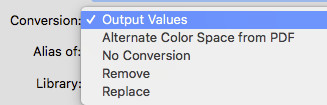
Conversion: Offers five processing options for spot colors:

  • Output Values: This is the default setting for the conversion of spot colors to process colors. Output values are automatically calculated by ZePrA. The calculated output values are grayed out in the Optimize Output Values field below.
  • Alternate Color Space from PDF: Ignores the library and uses the alternate color value (alternate color space) defined for the full tone of the spot color in the PDF file. This option is available to prevent/minimize compatibility issues with standard conversions in other tools. However, the high-end ColorLogic technology is used to calculate overprinting colors.
  • No Conversion: Leaves the spot color untouched.
  • Remove: Deletes all appearances of the spot color from the file.
  • Replace: Allows to change the name and values of a given spot color in a file.

Apply to: Specifies whether the color conversion is applied to Images only, Vectors only, or both. The default setting is Images and Vectors. This allows to create the same spot color twice and to perform different conversions for images and vectors.

Calculation MethodSeven calculation methods are available. The calculation method effects both, the automatic output value optimization, and, in particular, the overprinting of spot colors.

Note: If the checkbox Automatic under Optimize Output Values is enabled, the color values will be updated automatically when changing the Calculation Method.

  • Use Same Method as Configuration: The default setting. Uses the setting defined under Configuration/Spot Color.
  • Precise Match – Proofing: Reproduces spot colors on a proofing printer as precisely as possible. This method is not meant to be used in production as it may use all process colors to achieve the closest match (based on DeltaE 2000). The full tone is calculated so that the lowest possible DeltaE 2000 value results. No channel minimizing and print optimization is applied.
  • Visual Match – Utilize More Channels: The visually best conversion with high colorimetric accuracy and with good printability. Solid tones and gradients of spot colors are converted with a minimum of channels and are still colorimetrically accurate. Spot colors that are present in combination with process colors or other spot colors may consist of several process colors after conversion (up to four). This option is suitable for digital printing, large format inkjet printing or offset printing with a fine screen ruling.
  • Use the least Amount of Channels possible: Converts solid tones and gradients of the spot color with a minimum of channels and colorimetrically accurate, however after conversion, overprinting spot colors are composed of as few process colors as possible from the target color space. Choose this method for packaging printing, where the purest possible colors are to be produced. Single-color and two-color combinations are also included in the search for the best color combination. Mostly not more than three channels will be used for rendering the spot colors.
  • Use a Maximum of three Channels: Similar to the option Use the least Amount of Channels possible but makes sure that no more than a maximum of three channels will be used. Choose this method for packaging printing, where the purest possible colors are to be produced and no more than three process colors must be used for spot color conversion. Single-color and two-color combinations are also included in the search for the best color combination.
  • Use a Maximum of two Channels: Best for one or two process colors providing the best colorimetric match is automatically selected for each spot color. Results in very clean separations that are easily printed, but not necessarily very exact in colorimetric terms. It is recommended only for individual, manually created spot colors.
  • Use one Output Channel only: Useful for print packaging production. The spot colors used for text and bar codes should be converted using a maximum of one process color.

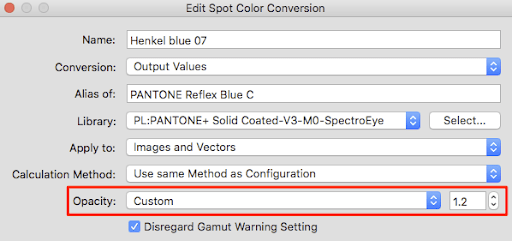
OpacityAllows to adjust the opacity from within the configuration which provides a quick and easy way to apply different opacity levels without the need to open the library.

  • Automatic: Uses the opacity values from the spot color library. Zero corresponds to no opacity.
  • Custom: Allows to enter a user defined value. This setting overwrites the library opacity.
    Note: This allows opacity changes for PantoneLIVE colors which currently can’t be set in the library.

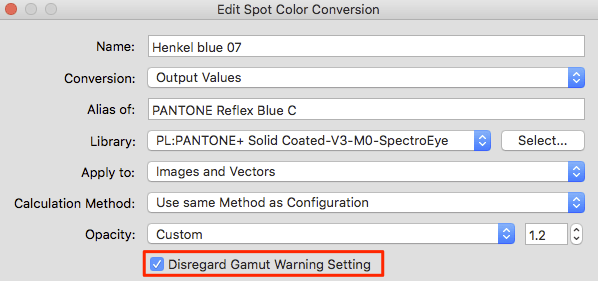
Disregard Gamut Warning Setting: Enabling this checkbox ignores any gamut warnings set for the selected spot color in the Configuration/Spot Colors/Gamut Warning dialog. This is useful if it is known and accepted that certain spot color conversions have higher deltaEs while other spot color conversions should be within the defined deltaE2000 Limit and should raise a warning if exceeded.

Optimize Output Values

This section provides numerous possibilities for controlling how the solid tone of your spot color is to be converted to the target color space. The color channels displayed correspond exactly to the channel names used in the target color space and later in the converted PDF file.

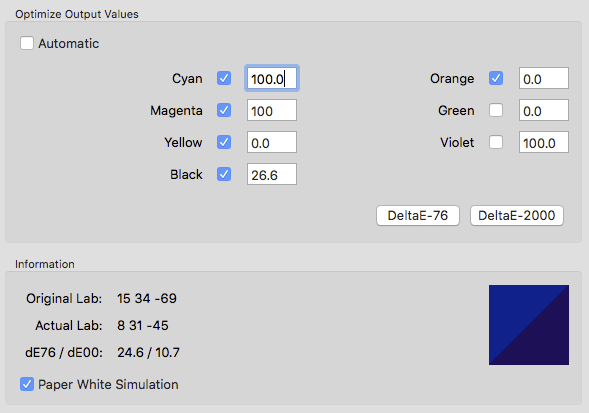
The Automatic checkbox is activated by default, ensuring the best possible optimization of the conversion in terms of printing and color based on the selected Calculation Method. The calculated process colors are grayed out in the value fields and can’t be edited. The Information section shows the Actual Lab and deltaE76/deltaE2000 values calculated for the spot color.

If the Automatic checkbox is deactivated, process color values can be entered in the number fields. The expected color impression (based on the entered values) is displayed as Actual Lab and in the color preview. Try different values to obtain best the color result.  

It is also possible to specifically map a spot color onto a process color channel by entering a value in the required channel and setting the other channels to zero.

Use the DeltaE-76 or DeltaE-2000 buttons to perform the best possible color calculation based on specified values for the channels of the target profile. The Lab color value is calculated and displayed under Information, as is the expected color difference compared to the original color in deltaE76/deltaE2000. Using the two buttons, the calculation is performed strictly according to the colorimetric rules and does not take any technical printing aspects into account, which would be the case when using the Automatic function where channel minimization takes place.

Tip: When minimizing deltaE, use the checkboxes for the process colors to manipulate the calculation. Only active channels are affected by the calculation.

Example: If the value of an individual channel is to be kept, enter this value and deactivate the channel by unticking the checkbox. If zero is entered and the channel is deactivated, the channel will not be used. When calculating the minimum DeltaE with one of the two buttons, the 100% value of this channel is taken into account for calculation, but not changed.

In the Information area, Original Lab shows the measured value from the library while Actual Lab shows the color value calculated with the selected process colors of the target profile.

In addition, the expected color difference is displayed in both, DeltaE76 and DeltaE 2000.

With Paper White Simulation enabled, the coloration of the substrate, which represents the target color space, is taken into account. Calculation of the Original Lab, Actual Lab value and color distances (DeltaE) is performed accordingly.

Note: It is recommended to enable Paper White Simulation.

Split Color Preview: The split color preview shows how the original color (top, left‑hand triangle) and the calculated color (bottom, right-hand triangle) will look when printed. The color preview is in true color on a calibrated and profiled monitor.

Spot Color List

Use the list to check specific spot colors or to define their conversion independently from the automatic processing in ZePrA. There are various ways to add relevant spot colors to the list.

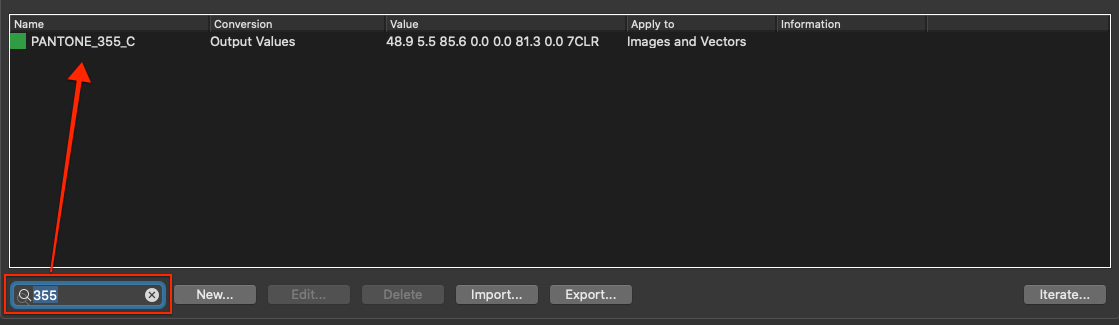
The search function can be used to find specific spot colors quickly. Spot color libraries can also be searched for Lab values. If the search text is of the form "L a b Lab", ZePrA searches for spot colors matching the specified value. Since exact matches often fail due to rounding and non-precise input, a tolerance is applied.

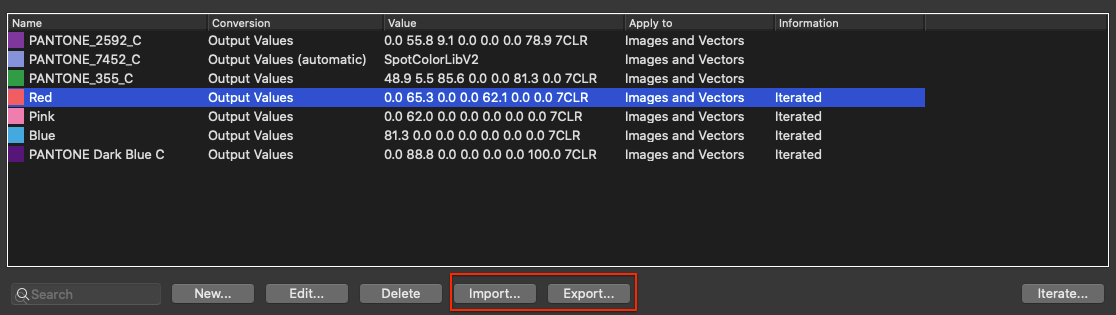
Name: Displays the spot color names

Conversion: Displays the method of conversion – Output Values, Alternative Color Space or No Conversion. Settings can be changed in the Edit Spot Color Conversion dialog.

Value: The spot color table indicates whether the target values are calculated automatically or if they have been set manually. If target values have been set manually, they are shown as numeric values in the Value column.

Apply to: Shows what the conversions have been applied to - Images only, Vectors only, or both Images and Vectors according to the settings of the Edit Spot Color Conversion dialog.

dE76/dE00: Displays the deltaE values (dE76/dE00) for custom spot colors. The deltaE values of this table are automatically updated on-the-fly each time the settings for spot colors are changed (this can take a few seconds).

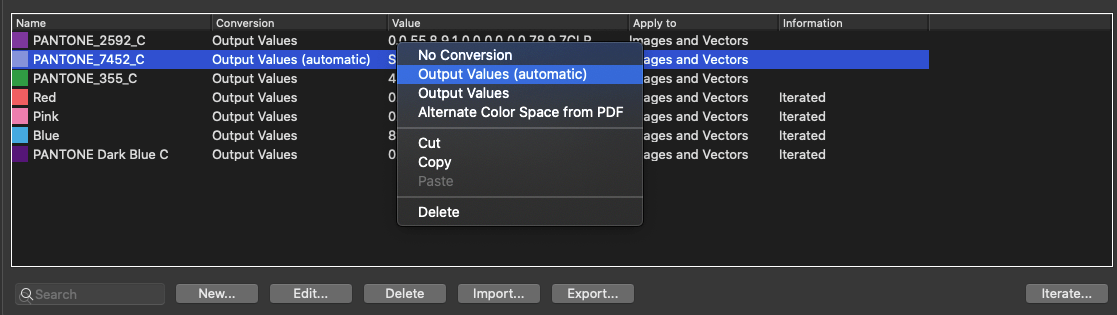
New, Edit, Delete: Access and edit the processing options for spot colors by:

  • Clicking on New
  • Double-clicking on a spot color in the table or selecting an entry and enable Edit  

Export and Import: These functions allow you to export rules from a configuration and import them into another configuration.

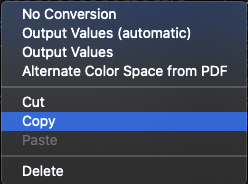
Context menu: Right-Click on one of the spot colors to bring up a context menu which can be used to change the processing mode individually for selected spot colors. In addition Cut, Copy, Paste and Delete are available.

Note: A simple way to use a spot color setting in another configuration is to Copy an entry in the table via the context menu, navigate to the Spot Colors tab of the other configurations and transfer it in the table via the context menu with Paste.

Iterate - Spot Color Iteration

Iterate spot colors to improve color differences (expressed in deltaE2000) until the measured deltaE values are within the desired tolerances.

Detailled information can be found under Spot Color Iteration.

Working without the Spot Color Module

Without a Spot Color license, it is not possible to create or use color libraries. Accordingly, the Global Setting for creating Spot Color Libraries is not available on the navigation panel.

In the Spot Colors tab under Configuration in ZePrA, use either the Convert Spot Colors checkbox or Convert with Alternate Color Space and Tint Transform to resolve and convert all spot colors created as DeviceN colors. However, only the alternate color value stored in the PDF is used for the conversion. This alternate color value may be indicated as CMYK, RGB or Lab color definition.

Depending on the color space of the Alternate Color Space, colors are processed with the CMYK, RGB or Lab settings made under Images/Vectors in ZePrA. Be sure that the selected settings match the conversion goals. Conversion via the alternate color space is very limited compared to using spot color libraries and, for quality reasons, is not recommended.

The option Don’t Convert Spot Color “All” under Special Options is automatically activated to prevent unwanted conversion of register marks and other printer marks.

Without a spot color license, the options for selecting Spot Color Libraries and Calculation Methods are grayed out and cannot be used, as are all the other quality options.

In the table below, use the New button to enter the name of a spot color that you want to exclude from conversion.  

In the Edit Spot Color Conversion window, enter the exact name of the spot color as indicated in the PDF. The use of upper and lower case letters is not important in this context and is automatically recognized by ZePrA.

Select No Conversion in the drop-down menu Conversion.

Other spot colors to be resolved with the PDF substitute color (alternate color space) do not need to be explicitly specified because the PDF alternate color space is always used automatically. ZePrA’s other (very useful) processing options are not available without a spot color license.

Note: Purchase the additional module for processing spot colors at any time.

ZePrA | Configurations | Document/Target

Document/Target

Settings for the Conversion from Document to Target Color Space

Document/Target

Document Color Space

The document color space acts as a reference to define a uniform color space for the colors of the PDF file.

  • CMYK color spaces are usually used for print production, as CMYK colors are generally used for printing.
  • RGB document color spaces are suitable for web, mobile or multimedia applications.
  • Multicolor color spaces are often used in HiFi packaging printing, ECG (Extended Color Gamut) printing or in modern digital printing.

ZePrA supports the full spectrum of color spaces (Multicolor color spaces require a corresponding Multicolor license). If there are individual RGB or CMYK objects with embedded profiles in PDF files, these are converted to the document color space by default (except in Auto Setup mode Direct Color Conversion to the new Output Condition). If necessary, this can be changed in the Images/Vectors tab. For professional print productions, the data exchange is based on the PDF/X standard.

The document color space can be defined either by the output intent of the PDF/X file or by the ICC device profile that was (most likely) used when the document was created. If the file does not contain an output intent, select an ICC device profile under Document Color Space. The color space of the selected profile is displayed next to the drop-down menu.

Prefer Output Intent

In PDF/X documents, the document color space is defined by the output intent. By activating this checkbox, the output intent of the PDF/X file is used vs. manually setting the document color space.

For non-PDF/X documents, select (in addition to the ICC device profiles of the individual PDF file objects) an ICC device profile as the document color space that defines the color space of the entire PDF document.

If Prefer Output Intent is enabled, PDF/X files with several output intents can be correctly converted in a queue because the respective output intent is considered instead of the document color space. In this case, it is recommended to work with SmartLink instead of a fixed DeviceLink profile when converting from document to target color space.

Notes:

  • This function is only suitable for PDF/X files.
  • If you have reason to believe that the output intent of a PDF/X file has been set incorrectly, specify a suitable ICC profile as the Document Color Space and uncheck the Prefer Output Intent checkbox.
  • The Prefer Output Intent option should not be used together with the Conversion MethodDeviceLink Profile” as it can produce undesirable results when the output intent profile of a PDF is not identical with the source profile of the used DeviceLink profile.

PDF 2.0 Support

PDF 2.0 files can have page level output intents. In regards to color conversion, the means different pages can contain different output intents. The checkbox Prefer Output Intent in the Document/Target tab must be enabled to consider this type of output conditions for the conversion. If the checkbox is enabled all objects on each page will be converted to the Target Color Space with the settings defined under the Image/Vector and Document/Target tabs using the corresponding output intent of each page.

Disabling the checkbox ignores the page level output intents and the conversion is done for all pages using the same source ICC profile defined as Document Color Space.

Another major feature of PDF 2.0 files is the support of black point compensation in combination with the relative colorimetric rendering intent.

Target Color Space

Under Target Color Space, select the target ICC profile. If the document color space/output intent of a PDF/X file does not match the color space of the final printing process, the entire PDF file needs to be converted from the Document Color Space to the Target Color Space. For the best quality of the conversion DeviceLink profiles or SmartLink can be used.

In addition to the selected target profile, the color space of the target profile is also shown, which is especially useful for Multicolor profiles with 5, 6 or 7 channels.

Moving the mouse over the color space icon displays the channel names of the Multicolor target profile.

If CoPrA profiles with viewing conditions other than the standard are selected in the Configuration (e.g., D65 and 10 degrees, as typically used in textile printing), this is indicated by a light bulb icon next to the profile drop-down menu.

When hovering the mouse pointer over it, the Viewing Condition (e.g., D65, 10 degrees) is displayed and set automatically in the CIE Conversion.

Note: The light bulb icon only appears for non-standard viewing conditions. The viewing condition can be changed manually under Viewing Condition/CIE Conversion in the Options tab. However, this could have undesirable consequences and cause a workflow warning.

Setting the Target Color Space

The Target Color Space is defined by the target profile selected in the drop-down menu. If the configuration was created with Auto Setup, the selection is automatically made by selecting the target profile or a DeviceLink. If required, the target profile can be changed here.

Embed into Output File: Embeds the target profile into the file after conversion.

Maintain Output Intent: The output intent of the file is used as the target profile instead of the selected target profile. The colors are converted to the output intent instead of the selected target profile.

This function should only be used if no changes to the output intent are necessary, or when simply normalizing a PDF/X file.

Usually, it is not intended to leave the output intent unchanged during color conversion. However, if this is required, set the Output Intent PDF/X in the PDF tab to Don't change.

Notes: If the file has no output intent, this option has no effect.

Embedded profiles in image files (TIFF, PSD, JPEG) are not regarded as output intent. Therefore, this function has no effect on image files.

Minimize Output Channels: Reduces the number of channels to the bare minimum required to process the job without compromising the quality significantly.

If a Multicolor target profile is used and spot colors are to be converted, it is often not necessary to use all Multicolor channels. Depending on the spot colors used, 4, 5 or 6 channels can be sufficient for a given job. Having fewer channels in digital printing saves click costs and inks, and in traditional printing it saves plates and inks as well.

To reduce the number of channels, ZePrA calculates and creates several variants of the original Multicolor target profile that use fewer channels. For example, based on a 7C target profile, ZePrA creates a CMYK profile, three 5C profile variants, and three 6C profile variants - this can take some time. All these eight profiles are automatically analyzed to determine the best profile, which is then used for the conversion of the job - this check is done quickly. The beauty of this feature is that when processing multiple jobs with different spot colors, different profile variants can automatically be used in the same configuration.

Notes:

  • If the profile variants for the given target profile have already been created by CoPrA, ZePrA can use those existing ICC profiles and does not need to recreate them, which speeds up processing.
  • The option is available only when a Multicolor target profile is selected, and it generates the most benefit when the spot color conversion is enabled (in the Spot Colors tab).
  • If jobs without spot colors are to be converted, the file will be converted to CMYK, as this results in the minimum number of channels with still acceptable quality.
  • The Minimize Output Channels option is available for the SmartLink and Device Profile Conversion Methods. It is grayed out in case the conversion is done with a specific DeviceLink Profile or if No Conversion is to be performed.
  • The Minimize Output Channels option is also grayed out when the Maintain PDF Output Intent checkbox is on.
  • If a specific spot color rule has been set up in the Spot Colors tab, a workflow warning is displayed. In such cases, the Minimize Output Channels option cannot override the spot color rules and may not work as intended.

All calculated Profile Variants are also included in the Job Properties Report, which is available in the context menu that appears after right-clicking on the job in the list of Processed Jobs. The report shows the results for spot colors converted with all the profile variants, alongside the profile that is actually used for the job indicated as the target profile. This is helpful to understand why the automatically selected Best profile variant has been used by ZePrA.
Note: The evaluation ZePrA uses to determine the best profile is the same as in the Spot Color Report to determine the best configuration. It considers the average and maximum deltaE2000, as well as the number of channels, and is explained in more detail here: Spot Color Report

Apply Correction DeviceLink Profile

Variations in printing due to new paper batches, different tone value increases, or changes in inks can be compensated for with updated profiles and Correction DeviceLinks.

Apply Correction DeviceLink Profile: This checkbox becomes available when a Correction DeviceLink profile for the target color space exists.

  1. Create a Correction DeviceLink profile with CoPrA.
  2. In ZePrA, activate the Apply Correction DeviceLink Profile checkbox under Configurations in the Document/Target tab.
  3. Click Settings and select the Correction DeviceLink profile.
  4. Embed the updated Target Profile instead of the Target Profile: Embeds the corresponding optimized target profile into the converted file. This profile then becomes the new output intent of the converted PDF file. The corrected target profile is displayed.

Note: ZePrA checks whether suitable Correction DeviceLink profiles and optimized printer profiles exist for the selected Target Color Space. Only corrected or optimized profiles are shown and can be selected after activating the Apply Correction DeviceLink Profile checkbox. If there are no Correction DeviceLink profiles, the checkbox is grayed out.

Conversion

Conversion Method
There are four conversion methods:


  1. DeviceLink Profile
    Conversion of the complete PDF document via a DeviceLink profile
    A DeviceLink profile represents a tailor-made color conversion from a defined source to a target profile. Within the ICC standard, a PSID tag can be used in the DeviceLink profile to store information regarding the source and target color spaces of the DeviceLink profile. If a DeviceLink profile has been selected, ZePrA can read its PSID tag and automatically define the profiles under Document Color Space and Target Color Space.
    Note: All ColorLogic DeviceLink Sets from profile version CoLoV3 and higher contain PSID tags.
  1. SmartLink
  1. Select SmartLink as Conversion Method (only available if licensed)
  2. Select the SmartLink Method to be used for on-the-fly calculation of DeviceLink profiles from the Document Color Space to the Target Color Space.
  3. Select the appropriate Rendering intent
  1. Device Profile
    Conversion of the PDF document with an ICC device profile
    Converts the PDF document from the Document Color Space to the Target Color Space using the ICC device profile set under Target Color Space. Select the corresponding Rendering intent.
  1. No Conversion
    The document is not converted to the Target Color Space. Other color conversions defined under Images/Vectors or Gradations or Spot Colors still take place.
    Example: A basic print-ready PDF (which does not need to be converted) still contains spot colors that must be converted to process colors.
Rendering

General information on the design of ICC device profiles

Rendering intents, such as Perceptual or Relative Colorimetric with CMYK profiles, contain large tables which convert either CMYK color values to Lab or Lab color values to CMYK.

Due to the nature of ICC Profiles that can be used in two directions, there are two tables for each rendering intent. The tables are calculated from the measurement data when a color profile is generated.

If ICC device profiles are calculated from the same measurement data – but with different profiling programs – then the tables generated can differ considerably in some color ranges.

This is especially true for the two tables of the Perceptual intent, for the gray balance and also for areas with very high color saturation in the two tables of the Relative Colorimetric intent (also called "Out of Gamut" colors).

For optimal and harmonious color conversion, it is recommended (especially with CMYK-to-CMYK color conversions) to ensure the source and target profiles were calculated with the same profiling software.

Profiles from different providers (such as Adobe, ECI, or ColorLogic) are often used in practice, which can lead to problems in color conversions based on the perceptive rendering intent.

These problems can be avoided by using SmartLink.

The SmartLink module uses the source profiles embedded in PDF or image data and automatically calculates the DeviceLink profile required for conversion between source and target for each object and applies it at the object level. The main conversion from the document color space to the target color space is also carried out via SmartLink. SmartLink is ideal for processing external data from a wide variety of sources to ensure optimum color accuracy (via DeviceLinks).

Additional SmartLink Rendering Intents

The SmartLink module provides several additional rendering intents to avoid problematic color conversions, which can result from tables calculated differently  for source and target profiles.

To ensure precise color conversions, ZePrA completely recalculates the conversion of source and target profiles on-the-fly. The algorithms are the same as in ColorLogic’s CoPrA profiling software.

Note: These additional rendering intents are only available with SmartLink enabled. If the checkbox Use SmartLink is not activated or SmartLink has not been licensed, only the four standard rendering intents will be available.

Automatic from Preset: This option is for Custom SmartLink Methods shared from CoPrA and takes whatever setting has been selected in the shared DeviceLink setting from CoPrA, including the rendering options, like a merge between two rendering options, chroma or saturation boosts, all exceptions and black generation settings.
Note: Automatic from Preset is only available in the drop-down menu when a custom SmartLink Method is selected. So, first select a custom SmartLink Method and the option Automatic from Preset will be on top of the list.
Note: In earlier versions of ZePrA (9 and lower) it is not possible to merge two different rendering options for color conversion, because the rendering settings of a profiling setting shared from CoPrA are always overwritten by the rendering setting selected in ZePrA.

Standard Compression: This is the default method. It uses a perceptual conversion that is well suited for all types of gamuts, i.e., also for conversions between color spaces of different sizes. Neutral tones are converted using a relative colorimetric approach, and the appearance of the gray axis always depends on the paper white of the target profile. Therefore, the gray axis of the transformed file will appear yellowish on a very yellowish paper. The same gray axis will appear bluish on a bluish paper. For very small color gamuts, for example in newspaper printing, the dark tones are raised slightly to achieve more image definition in these areas.

Blackpoint Compensation: Use Blackpoint Compensation to achieve the same results with a perceptive conversion as with “Relative Colorimetric with Black Point Compensation”. When converting from large to small color spaces, the image definition is preserved in the highlights and shadows, unlike with a pure Relative Colorimetric conversion. Neutral tones are converted using the Relative Colorimetric intent. Out-of-gamut colors are cut off.

Absolute Compression: This method is based on the absolute colorimetric rendering intent in terms of color reproduction and is recommended when the paper tones differ significantly (the color gamuts can be similar or different). In contrast to the Standard Compression and Blackpoint Compensation, the paper tint is compensated in the gray balance. The rendering of neutral colors is based on the absolute colorimetric rendering intent, without paper tone simulation in the highlights. If, for example, the paper white is significantly more yellow than in the reference, the gray axis appears neutral despite the yellowish paper tone. This ensures that the color appearance of the original file is preserved as best as possible on a target medium with a different paper tint. The contrast range in the highlights and shadows is adapted to avoid any loss of image definition.

Minimum Compression (Paper Absolute): This method is largely similar to the absolute colorimetric intent and only compensates close to the black and the white point.
In addition, the white point of the source color space is not simulated, but scaled to the white point of the target color space, thus ensuring a pure paper white.
Use this rendering intent to achieve a close reproduction, for example when using print standards such as ISO Coated V2 or GRACoL2006 Coated1v2 on a digital printer.
Note: As for the absolute colorimetric rendering intent, ensure that the target color space is larger or has at least a similar size to avoid any loss of image definition. For color conversions from larger to smaller color spaces use Absolute Compression to maintain the gray balance of the source color space.

Minimum Compression (Paper Relative): This method is largely similar to the relative colorimetric intent and only compensates close to the black and the white point. It is similar to Minimal Compression (Paper Absolute) but uses relative colorimetric instead.

Dynamic Compression: Compares the source color space with the target color space and generates a compression that minimizes out-of-gamut areas. This setting preserves the brightness of the original color space while reducing the saturation, and therefore also preserves the image definition. As for the Standard Compression, the gray axis of the conversion is built relative to the paper white of the target profile. This approach is well suited when the source and target profiles have a very large dynamic range and contrast, for example, in RGB-to-CMYK conversions.
Note: This method is now only available in ZePrA for compatibility reasons, and no longer in CoPrA. We recommend using Automatic Paper Relative instead.

Minimum White Compression: This method is similar to Minimum Compression (Paper Absolute). Both rendering intents compress the white point without paper simulation, however, there is an important difference: The Minimum Compression is a rather perceptual rendering that additionally compresses the black point, so the maximum dynamic range is utilized without loss of detail in the shadows. In contrast, the Minimum White Compression compresses the white point but not the black point, so a close absolute colorimetric match between source and target color spaces can be achieved. This can be useful for the color representation across various media, color matching or printing on slightly differing media. It can be regarded as close to absolute colorimetric rendering without paper tint simulation.
Note: Remember that the target color space should be larger than the simulated color space (or similarly large) to avoid loss of detail and vividness (similar to the absolute colorimetric rendering intent). For conversions from large to small color spaces, instead use our rendering intent Absolute Compression if the gray balance of the source color space is to be preserved.

Automatic Paper Relative: A paper relative rendering without consideration of the paper tone. Leaves the gray balance with the paper tint as is. A typical use case would be a rather more colorful but still faithful rendering of a color space on a different printer. For example, a campaign prepared for ISO coated V2 but rendered on a large format inkjet printer without consideration of the paper tone.

Automatic Paper Absolute: A paper absolute rendering with consideration of the paper tone. For a gray balance that compensates the paper tint. A typical use case would be the same as for Automatic Paper Relative, but with consideration of the paper tone.

Important: For PDF processing ZePrA typically uses the rendering intent defined in the PDF for each object. When deviating from this rule, ensure that an on-the-fly DeviceLink profile created with SmartLink uses the rendering intent set under Configurations > Images/Vectors, select the checkbox Ignore PDF Rendering Intents in the Options tab.

SmartLink Method

The SmartLink function uses the ICC device profiles set in ZePrA, or embedded in images and PDF files, to create DeviceLink profiles on-the-fly. Supported color space combinations include:

Supported color spaces for Document and Target Color Space are:
Gray, 1 channel to 3 channels including CMY (Multicolor 1-3), RGB, CMYK, 4 channels to 15 channels (Multicolor 4-n)

Note: CMY profiles are supported as Document Color Space (from ZePrA 12 and higher) which offers some possibilities for workflows that use CMY channels exclusively, such as proofing digital printing devices that use CMY to increase production speed and save clicks, or workflows that convert between CMY printers to balance workloads.

Predefined SmartLink Methods (Presets)

The SmartLink Method considers the specific requirements of different printing conditions, so that the printed color is correctly reproduced and optimally separated for the printing process.

Note: The SmartLink Method drop-down menu provides presets for Multicolor if the checkbox Prefer Output Intent is enabled. This allows for automatic processing of PDF/X-5n or PDF/X-6n files with Multicolor output intent.

Traditional Printing – Classic: Conversions for offset, gravure, or newspaper printing. The DeviceLinks created ensure that black and gray, as well as the primary, secondary and triplex hues of the source profile, are preserved. The total area coverage is taken from the target profile.

Traditional Printing – Automatic: Select this setting when the colors and paper of the target color space are significantly different from the output intent or document color space. Separation is preserved, but Exceptions for special colors such as black and gray, primary, secondary, and triplex colors are automatically calculated based on both profiles.

Large Format Printing – Inkjet: The separation settings and the total area coverage are taken from the selected target profile. The Exceptions for special colors, such as black and gray, primary, secondary, and triplex hues, are automatically calculated based on both profiles. This is to avoid problems that can occur when the hues of the primary inks vary between different inkjet printers or between the inkjet printer and the source color space (as with ISOcoated V2 or GRACol).

Digital Printing – Toner: For toner-based digital printers and office printers. The separation method ensures a high percentage of black and an early black start. This will achieve a stable print and neutral gray balance. The total area coverage is taken from the target profile. The Exceptions for special colors, such as black and gray, primary, secondary, and triplex hues, are automatically calculated based on both profiles.

Proofing: For proofing applications. All exceptions are disabled. All separation settings of the target profile are applied. The rendering intent should be set to Absolute Colorimetric. When using the Proofing method in the Auto Setup Wizard, the rendering intent is automatically set to Absolute Colorimetric.

Multicolor – Preserve CMYK: This method ensures that CMYK objects in PDF files or CMYK image files remain CMYK when converted to Multicolor.
Other color spaces, such as RGB or spot colors (when conversion is enabled), are converted to Multicolor using the black and color generation of the target profile to achieve optimal color fidelity. For image and vector conversions, color exceptions are generated automatically.

Note: All methods that automatically calculate Exceptions can result in grey, primaries, and secondaries being built with multiple colors, which can lead to overprinting problems in complex PDF files. If SmartLink has not been licensed, the Auto Setup Wizard creates configurations differently to avoid overprinting problems. Without a SmartLink license, CMYK objects with embedded profiles are treated like objects without profiles and are converted with the selected DeviceLink profile.

In general, if a predefined SmartLink Method (one of the Presets) has been selected, no further SmartLink settings need to be changed.
Note: In contrast to using a predefined SmartLink Method, when using Custom as a SmartLink Method SmartLink settings must be reviewed and adjusted if necessary!

TAC Reduction: Reduces the total amount of ink applied while maintaining color perception. This method is only available if the CMYK profiles for the Document Color Space and the Target Color Space are identical.

The required maximum ink application can then be specified in percent under Settings. By default, the TAC settings are read from the profile of the Target Color Space.

SaveInk: Reduces overall ink application while maintaining color perception. This method is only available if the CMYK profiles for the Document Color Space and the Target Color Space are identical. Predefined methods can be selected under Settings. With Import, you can also import your customized settings created (and exported) with CoPrA. SaveInk requires ZePrA XL or higher, or a SaveInk and SmartLink license.

SaveNeutral: Moderately increases the amount of black in neutral color areas. Ideal for print shops looking for a quick introduction to saving ink and wanting to gain practical experience. These profiles primarily stabilize the printing process and are less suitable for saving large quantities of ink.

SaveStrong: The black portion is significantly increased. This is aimed at print shops that have control of their printing process in accordance with standardization and are looking for high ink savings, but still want to leave room for adjustments on the press.

SaveMaximum: Maximizes the amount of black and provides the greatest ink savings. Mainly suitable for print shops that have successfully implemented standards and control them completely.

For Multicolor SaveInk profiles, SaveInk Settings can be defined independently for CMYK and Multicolor (Multicolor 4-n) components.

Apply SmartLink conversion on equivalent Source and Target Profiles: By default, ZePrA skips conversions of source and target color spaces with identical profiles to avoid unnecessary color changes. Enabling the checkbox ensures conversion between Image and Vector color spaces to the Target Color Space or between Document and Target Color Spaces with equivalent profiles using the selected SmartLink Method.

Note: ZePrA contains an internal list of almost all known standard profiles. Many of these standard profiles are available in several variants which are also included in the list. These variants are the equivalent profiles recognized by ZePrA.

Equivalent profiles are for example: ISOcoated V2.icc, ISO coated V2 (300).icc, CoatedFOGRA39.icc, ISOcoated V2 (bas).icc

This option does not apply to conversions from Image/Vector to the Document Color Space.

Using CoPrA's DeviceLink Settings in ZePrA

Due to the close connection between CoPrA (ColorLogic’s profiling solution) and our color server ZePrA, the profile settings from CoPrA can be used to calculate DeviceLink profiles in ZePrA.

Detailed information on how to share CoPrA’s DeviceLink settings with ZePrA can be found under Share with ZePrA.

Custom SmartLink Settings

Custom SmartLink Settings

When Custom has been selected as SmartLink Method, the Settings button is enabled allowing customization of the conversion between color spaces.

Settings: In the SmartLink Settings window, specify how to convert between color spaces. This includes the conversion from the Document Color Space to the Target Color Space as well as from the color spaces in the Images/Vectors tab either to the Document Color Space or to the Target Color Space.

For all color space conversions, presets or custom settings (created by CoPrA) can be selected. Import can also be used to import custom settings created (and exported) by CoPrA.

Note: Use Custom SmartLink Settings with caution, as they are only appropriate for the color space combination for which they are intended. When using a Custom SmartLink Setting, the color spaces are not automatically adjusted. Therefore, a CMYK-to-CMYK preset will not work for a target profile that has been changed to RGB or Multicolor and will result in warning or error messages.

In contrast to using a predefined SmartLink Method, when using Custom as a SmartLink Method, SmartLink settings must be reviewed and adjusted if profiles and color spaces for Document and/or Target Color Space are changed!

Multicolor 1-3: Provides SmartLink presets that cover 1CLR to 3CLR profiles, including CMY, which can be selected as Document Color Space. Enables the use of 1CLR to 3CLR SmartLink presets independently of other Multicolor SmartLink presets.

Note: The Multicolor SmartLink option is intended for source profiles with 4 or more channels (except CMYK). The Multicolor 1-3 option covers source profiles with 1 to 3 channels, including CMY.

Apply SmartLink conversion on equivalent Source and Target Profiles: By default, ZePrA skips conversions of source and target color spaces with identical profiles to avoid unnecessary color changes. Enabling the checkbox ensures conversion between Image and Vector color spaces to the Target Color Space or between Document and Target Color Spaces with equivalent profiles using the selected SmartLink Method.

Note: ZePrA contains an internal list of almost all known standard profiles. Many of these standard profiles are available in several variants which are also included in the list. These variants are the equivalent profiles recognized by ZePrA.

Equivalent profiles are for example: ISOcoated V2.icc, ISO coated V2 (300).icc, CoatedFOGRA39.icc, ISOcoated V2 (bas).icc

This option does not apply to conversions from Image/Vector to the Document Color Space.

Using CoPrA's DeviceLink Settings in ZePrA

Due to the close connection between CoPrA (ColorLogic’s profiling solution) and our color server ZePrA, the profile settings from CoPrA can be used to calculate DeviceLink profiles in ZePrA.

Detailed information on how to share CoPrA’s DeviceLink settings with ZePrA can be found under Share with ZePrA.

DeviceLink Iteration

Overview

Iteration can be necessary to achieve the best possible color match, especially when proofing. To apply an iteration, a special test chart must be converted with the desired color management settings of a given configuration, printed and measured. Based on the measurements the DeviceLink profile can then be optimized. After one to three iteration cycles, a closer match in terms of DeltaE values is achieved. This process is error-prone if done manually, however, it is easy to accomplish with the help of the DeviceLink Iteration Wizard, which guides you through each step.

Video Tutorial

Overview of the DeviceLink Iteration Wizard in ZePrA.

Procedure

The iteration starts by selecting the configuration containing the DeviceLink to be iterated. This can be done in three different ways:

  1. In the Queues section of the Overview, select the queue and configuration you want to iterate. Open the context menu with a right click and select DeviceLink Iteration.

  2. Select DeviceLink Iteration from the Tools menu and search for the desired configuration in the Configuration drop-down menu of the appearing DeviceLink Iteration Wizard. You can use the same search and sort functions that you are familiar with from the Configuration drop-down menus elsewhere in ZePrA to find the configuration you are looking for.

  3. Open the desired Configuration in the Document/Target tab and click on the Iterate button at the bottom of the Conversion section.

The DeviceLink Iteration Wizard dialog consists of two tabs, the Current Iteration and the Archive tabs. The Current Iteration tab contains the actual iteration wizard and typically, if a configuration is selected that has not yet been iterated, the wizard is started directly there. The Archive tab contains all the iteration steps that have been carried out, including all the evaluation details.

Current Iteration

The wizard guides the user through the iteration process in these four steps:

  1. Create test chart to be printed
  2. Print and measure test chart
  3. View Evaluation Results
  4. Continue or end the iteration

Step One: Create the test chart to be printed

There are two possibilities to create the test chart. Either you use the included Default Iteration Chart, which of course is always optimized for the color space of the given configuration. Or, select your own reference file (TXT, CXF3, XML) of a custom chart under Custom Iteration Chart.

After that, define your measurement Instrument Settings. Various settings for the supported measurement equipment can be selected from the drop-down menu in the Measure Tool (the Measure Tool is included in ZePrA).

Note: ColorLogic ColorAnt users can create their own instrument settings optimized for their specific requirements in the Export Chart tool.

Click Save and choose a file format (PDF, TIFF or PSD) to create the test chart in the selected location. All color management settings of the configuration will be applied automatically.

Note: In some cases the creation of the chart may take some time, for example if the Conversion settings SmartLink or Device Profile are used in the configuration, as the wizard will then need to create a DeviceLink profile first.

After you successfully created the chart and the associated reference file, a message and a green check mark indicate that you can now proceed to the next step by clicking the Continue button.

Step Two: Print and measure test chart

The second step consists of two operations. First, the chart created in step 1 must be printed on the printer without color management settings. Then, after drying, the print must be measured. If the Measure Tool is to be used, simply click on the Measure button. You do not need to worry about the reference file and layout, as this is already preselected within the Measure Tool. Instructions on how to select your device and make measurements using the Measure Tool can be found here.

Note: Alternatively, you can use the previously exported reference file and measure your printed chart with a different measurement tool. Make sure that the measurements are saved in standard file formats that can be read by ZePrA, such as CGATS TXT, XML or CXF3. The external measurement files can be loaded using the Load button.

Once the measurement data has been transmitted from Measure Tool or loaded from external sources and it conforms to the printed chart a green check mark indicates a match and you can proceed by clicking Continue.

Note: When loading measurement data that does not match the chart layout or the corresponding patches in the reference file, you are alerted by a warning message and proceeding to the next step is not possible.

Step Three: View Evaluation Results

The third step shows the Evaluation Results of the measurements compared to the desired color conversion.

If all categories such as substrate, the maximum and average deltaE for all patches, etc. are within their limits they are marked green and the overall result is marked all right.

In a proofing case, e.g if an absolute colorimetric rendering intent was used in the configuration, the proof print is compatible with a Contract Proof according to ISO12647-7 and the wizard indicates this by a green check mark and a corresponding note text. A further iteration is then not required, hence the Don’t apply Optimization radio button is preselected.

However, the preselection can be overridden and another iteration cycle applied if the results are to be improved even further. To do this, select the Optimize DeviceLink and apply radio button and click Continue. Alternatively, apply the iteration later via the Archive tab.

If only a single category is displayed in orange or red in the table of Evaluation Results, the proof print is considered to be not okay and the validation has failed. In this case, a warning is displayed and it is suggested to apply an iteration to improve the result. The corresponding radio button Optimize DeviceLink and apply is then preselected.

By selecting Optimize DeviceLink and apply and clicking on Continue, an iterated DeviceLink is created on-the-fly and automatically entered in the configuration.

ZePrA checks for out-of-gamut colors and evaluates whether those colors can be improved. Color values that are displayed in red in the Evaluation Results and Report are considered to be out-of-gamut and their deltaE00 values can most likely not be improved. Nevertheless, an iteration can slightly change the rendering of out-of-gamut colors, for example, to correct hue errors when colors are far from the desired hue. Color values that are displayed in orange, however, can be improved with further iteration. If there are only red values left, ZePrA informs, that further iterations are of no use and preselects the Don’t apply Optimization radio button. If, however, there are orange values left, these can be further optimized and ZePrA suggests Optimize DeviceLink and apply.

Step Four: Continue or end the iteration

The fourth step concludes the iteration cycle. Here, there are three options to choose from. Based on the previous results, the wizard already preselects a logical option for you to follow:

  1. Optimize DeviceLink Profile again: Runs another iteration cycle, for example to check whether a previously iterated DeviceLink successfully passes the evaluation. If you select this radio button and click Continue, a new iteration cycle starts with step 1 and the creation of a new test chart to be printed.
  2. View the evaluation results in the Archive tab: If you have already completed several iterations or would like to see the evaluation results once more, select this option. When you click Continue, the Archive tab opens with the last iteration step highlighted.
  3. Close this dialog: If the evaluation results are all right or if you want to end the iteration process you can simply select Close this dialog and by clicking Continue the iteration is ended.

Archive

All data created during the iteration - such as test charts, reference data and measurement data, as well as the report - are stored in an internal database in addition to the save location defined by the user.

Therefore, if data is deleted from the save location it can still be restored from the internal database any time via the Archive tab. Users can stop an iteration process and even close the DeviceLink Iteration Wizard dialog at any time and can revert back to the last completed step with the help of the Information stored in the Archive.

The Archive tab shows all iteration steps and evaluation details. The History table contains a list of all iterations, with the active iteration highlighted. More information for the selected iteration step is displayed under Details.

The columns of the History table show the iteration step number #, the maximum DeltaE00 value dE00 (max), the average DeltaE00 value dE00 (avg), the Status of the selected iteration step and some Information about the iteration process itself, such as Optimization applied, when the measurements done from the printed test chart have actually been used to create an iterated DeviceLink, or Evaluation measurement, when the measurements have been used for evaluation only and have not been used to create an iterated DeviceLink.

In addition, the iteration process (being performed in the Current Iteration tab) can be discontinued, which is indicated with various messages such as Next step: save chart, Next step: measure or load data, Next step: Evaluate.

Right clicking on an iteration step in the History displays a context menu with the following options:

Save Chart: Exports the test chart into a file selected by the user. The test chart is not newly created but only copied from the internal database. This implies that the file selection only supports the file type initially chosen by the user.

Save Reference Data: Exports the reference data that belongs to the test chart into a file selected by the user.

Save Measurement Data: Exports the measurement data into a file selected by the user.

Save Report: Saves a report containing all Details displayed on the right and the full information about each measurement patch. This is useful to identify colors with the highest or lowest deltaE values, or colors which are out of gamut. The report is explained in more detail below.

Revert to state before: This is only available for iterations with the status applied. Reverts back to the state before this iteration, giving the previous iteration, if any, the applied state. The status changes to evaluation measurement. All subsequent items are deleted.

Revert to state after: This is only available for iterations with the status applied. Proceeds to the state after this iteration step, making it the active iteration. The status of a next iteration, if available, would be evaluation measurement. All subsequent items after the next iteration are deleted.

Apply Optimization: This is only available for iterations with the status evaluation measurement. It can be used for evaluation measurements that have not been applied in the iteration process itself. Use this option if you want to apply an iteration later on.

Evaluation Results

The Evaluation Results shown under Details are always the evaluations of the previous step. This means, if an iteration has been applied in step 1, the evaluation results shown under Details for the selected step 1 are the values before the iteration has actually been applied. Therefore, in order to see the results of the first iteration a second step is necessary. The evaluation results shown for that second step are actually the iteration results of the first iteration step, and so on. This offers the possibility to use the results of an iteration itself for a second iteration. But again, another measurement step is needed to find out if this iteration actually improved the result.

Evaluation measurements for the different Categories are shown according to the proof evaluation tolerances defined in ISO 12647-7. They can even be regarded as proof evaluation when an absolute colorimetric rendering intent has been used in the configuration. The values shown in the table can assume three different colored states that are green, orange or red. Values shown in green are within the Limit and therefore all right. Orange values are outside the Limit but can be improved by iteration. Red values are outside the Limit and cannot be improved. This is mostly the case if a source color can’t be reproduced in the target color space because it is out-of-gamut. An overall statement of the accuracy of the rendering is given below the table. A green check mark indicates that the color conversion is within the limits, whereas a red cross indicates that it is not.

Special cases arise if the rendering intent used in the configuration is not absolute colorimetric. In case of relative colorimetric or perceptual rendering intents the reference Lab values used to iterate the conversion need to be calculated from the initial DeviceLink profile. The measurements are then compared to those rendering intent specific reference Lab values. The iteration is still using the tolerances from ISO 12647-7 for the analysis of the iteration accuracy. However, since this conversion is not a proof print, a different statement results for the overall iteration accuracy compared to the iteration result with an absolute colorimetric rendering intent.  

The Report

By right-clicking on an iteration step in the left table, a report can be created for this step. The report can be saved in various formats such as PDF, HTML, XML and TXT. The PDF and HTML formats are the most common versions for end users, while the other formats are more intended for automation and usage in other systems such as a MIS (Management Information System). 

The report contains all displayed Details and the complete information for each measuring patch. This is handy for identifying colors with the highest or lowest DeltaE values or colors that are out-of-gamut. A Legend explaining the color highlighting in the DeltaE column is shown at the bottom of the last page of the report.